L-G Sinha highlights Kashmiriyat as core of Indianness
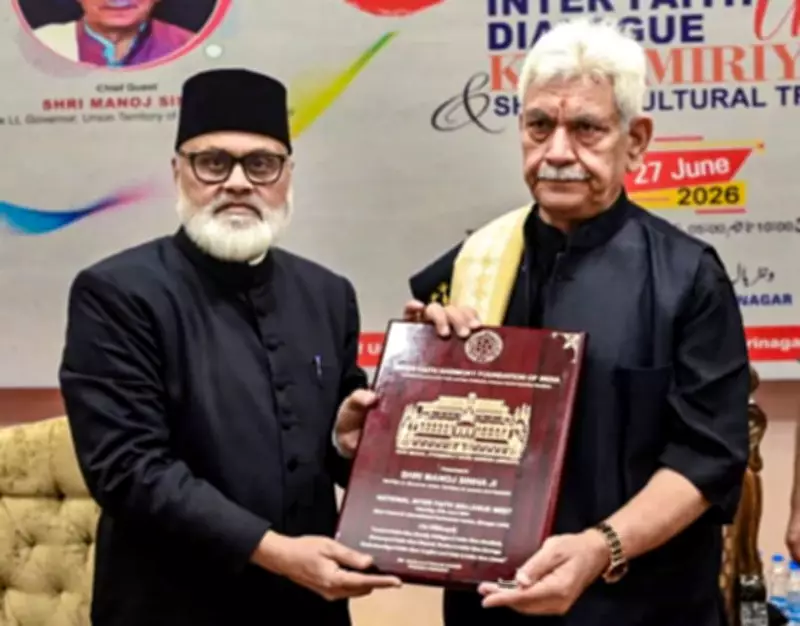
Jammu and Kashmir Lieutenant Governor Manoj Sinha on Saturday asserted that 'Kashmiriyat' is a manifestation of 'Bhartiyata' (Indianness) and embodies India's enduring tradition of equal respect for all religions, cultures, and traditions. Speaking at an Interfaith Dialogue organized by the National Council for Promotion of Urdu Language and the Inter-Faith Harmony Foundation of India, Sinha emphasized that the concept of Kashmiriyat springs from the philosophy of Bhartiyata, reflecting fundamental values India has shared with the world since the Vedic age.
Ancient wisdom on diversity and coexistence
“Thousands of years ago, our sages taught that truth is not confined to a single path. Truth is infinite, and there are many paths leading to it. India has always regarded diversity as a blessing, not a division. This spirit is reflected in the crown jewel of the country—Jammu and Kashmir—where harmony and coexistence have been part of life for centuries,” Sinha said.
Highlighting India’s civilisational legacy, Sinha noted that the country has long been rooted in mutual respect, allowing diverse faiths to coexist and flourish while promoting peace. “The world recognises that Sanatana Dharma, the world’s oldest living religion, never imposed itself but embraced diversity and coexistence. Ancient India provided a foundation of respect where Christianity, Islam, Judaism, and Zoroastrianism flourished,” he added.

India as a guiding light for global harmony
Sinha remarked that at a time when the world is grappling with conflicts and intolerance, Indian philosophy can serve as a guiding light by bridging divisions of religion, language, and race. Calling India “a living idea,” the L-G urged the younger generation to carry forward the vision of humanity living together as one family.
“In intellectual, spiritual, and cultural terms, I call this ‘Bhartiyata’—the ethos that offered the world the ideals of equal respect for all religions, unity in diversity, pursuit of truth, the idea of the world as one family (Vasudhaiva Kutumbakam), and a shared cultural consciousness. Our ancient scriptures, including the Vedas and Upanishads, have always advocated harmonious coexistence among people of different faiths,” he said.
Historical context: Islam and Sufi influence in India
Sinha also noted that when Islam reached India in the 12th and 13th centuries, Sufi saints and Islamic scholars found a civilisation rooted in love, spirituality, compassion, and equality. This historical integration further enriched the fabric of Indian society.
Former Union Minister Dr. Karan Singh, University of Kashmir Vice-Chancellor Prof. Nilofer Khan, Inter-Faith Harmony Foundation President Dr. Khwaja Iftikhar Ahmed, NCPUL Director Dr. Md Shams Equbal, Dara Shikoh Centre Founder Director Dr. Jyotsna Singh, and Inter-Faith Harmony Foundation Director (Operations) Dr. Nasreen Shama attended the programme.