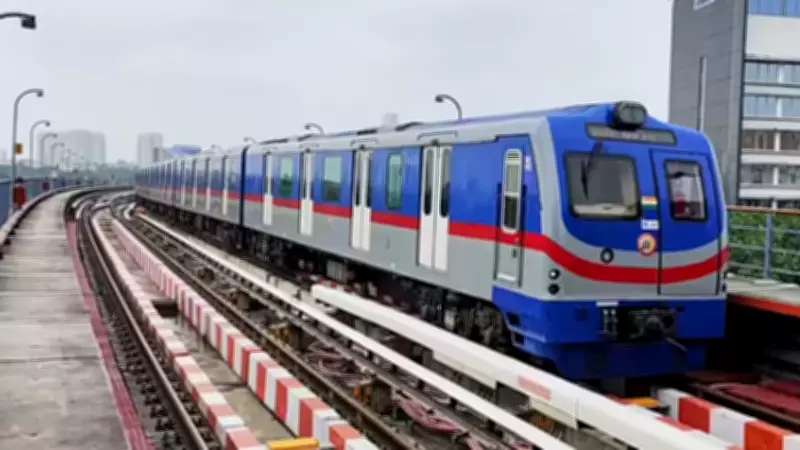
Kolkata Metro's Blue Line Achieves Milestone with India's First Battery Backup System
Commuters on Kolkata Metro's Blue Line, the North-South corridor, can now breathe a sigh of relief as it becomes the country's first metro route equipped with a battery backup system. This innovative technology ensures that trains can be safely transported to the next station in the event of a power failure, eliminating the need for passengers to walk on tracks during outages.
Launch and Functionality of the Battery Energy Storage System
The Battery Energy Storage System (BESS) was officially commissioned on Wednesday at a substation adjacent to Central station. Metro Railway General Manager Subhransu Shekhar Misra highlighted this achievement, stating, "India's first metro, operational since 1984, has set another benchmark with BESS, marking a pioneering step for Indian Railways." The system comprises converters that activate automatically when regular power supply is disrupted.
Prior to its launch, three rigorous trials were conducted using fully loaded rakes. These tests demonstrated the system's capability, with trains covering 20 kilometers at a speed of 55 kilometers per hour while switching to BESS after power cuts. Niranjan Nayak, Managing Director of Delta Electronics, the manufacturer, noted, "The final trial from Dum Dum to Netaji stations was successful, though BESS is specifically designed for the underground stretch between Dum Dum and Tollygunge." He added that the system can sequentially rescue up to 18 trains over a distance of 35 kilometers.

Technical Details and Benefits of the BESS
Principal Chief Electrical Engineer Asim Majumdar explained that the 4 MW system integrates inverters with advanced chemistry cell (ACC) batteries. "This setup generates electricity to haul stranded rakes from mid-tunnel to the nearest station, aligning with the National Programme on Advanced Chemistry Cell Battery Storage approved by the Union cabinet in 2021," he said.
Chief Electrical Engineer Jayanta Chakraborty elaborated on the design, emphasizing that BESS not only powers trains at 55 kmph but also supports tunnel ventilation and air conditioning systems in underground stations. The green batteries are projected to significantly reduce the metro network's energy consumption and electricity bills, contributing to environmental sustainability.
Addressing Larger-Scale Failures and Historical Context
Metro officials clarified that while typical glitches are localized to tracks or signaling, BESS is engineered to handle more extensive power failures. The initiative for this backup system was inspired by the July 2012 national grid collapse, which highlighted the vulnerability of metro operations during large-scale blackouts. This proactive measure aims to enhance reliability and passenger safety across the Blue Line.