PM Modi Delivers Historic Address to Israeli Knesset, Condemns Terrorism and Backs Peace Path
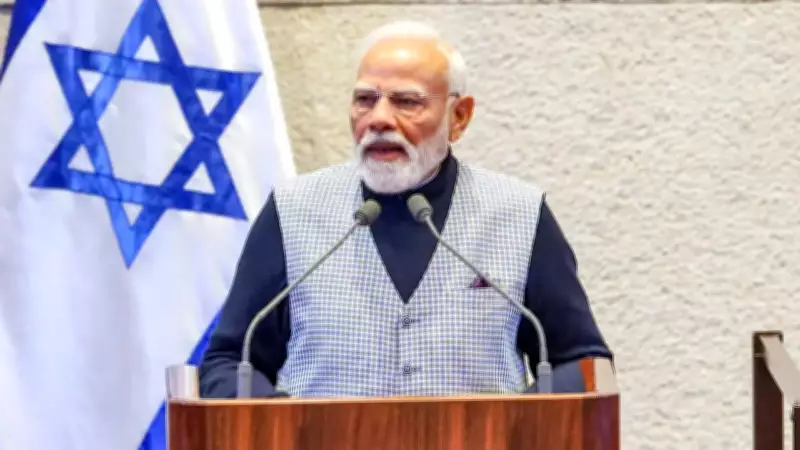
In a landmark moment for bilateral relations, Prime Minister Narendra Modi became the first Indian head of government to address the Israeli Knesset, where he delivered a powerful message of solidarity with Israel while outlining a vision for regional peace and stability.
Strong Condemnation of Terrorism and Solidarity with Israel
Prime Minister Modi unequivocally condemned the October 7, 2023, attacks, specifically naming Hamas for what he described as a "barbaric" act of terrorism. "We feel your pain, share your grief. No cause can justify the murder of civilians. Nothing can justify terrorism," Modi declared, drawing sustained applause from the assembled lawmakers.
The Prime Minister emphasized India's unwavering support for Israel, stating with full conviction that "India stands with Israel in this moment, and beyond." He drew direct parallels between Israel's security challenges and India's own experiences, particularly recalling the 26/11 Mumbai attacks, which claimed Israeli citizens among its victims.

India's Consistent Anti-Terrorism Policy
Modi articulated India's consistent and uncompromising zero-tolerance policy against terrorism, emphasizing that there are no double standards when it comes to combating this global threat. "Terrorism aims to destabilise societies, to block development, and to erode trust," he stated, adding that countering terrorism requires sustained and coordinated global action because "terror anywhere threatens peace everywhere."
Endorsement of Peace Initiatives and Regional Stability
While addressing the Gaza situation, Prime Minister Modi acknowledged that "the road to peace is not always easy" but affirmed that India stands with Israel and the international community in pursuit of dialogue, peace, and stability in the region. He specifically endorsed the United Nations Security Council-backed peace initiative, describing it as holding "the promise of a just and durable peace for all people of the region, including by addressing the Palestine issue."
Modi called for all efforts to be guided by wisdom, courage, and humanity, while noting the significant challenges that have emerged since the signing of the Abraham Accords, which India had strongly supported. "Some years ago, when you concluded the Abraham Accords, we applauded your courage and vision. It was a moment of new hope for a long-troubled region," he recalled, adding that while the path has become more challenging, it remains important to sustain that hope.
Strategic Partnership and Economic Cooperation
The Prime Minister positioned the India-Israel relationship as not merely serving national interests but as contributing significantly to global stability and prosperity. He highlighted the natural foundation for a forward-looking partnership, with India projected to become one of the world's top three economies and Israel established as a powerhouse of innovation and technological leadership.
Modi strongly backed ongoing negotiations for a comprehensive free trade agreement between the two nations, stating that "our teams are working hard to negotiate an ambitious free trade agreement that will unlock the vast untapped potential in our trade relationship." He noted that bilateral goods trade has grown manifold in recent years but still doesn't reflect the full scope of opportunity.
Defense Cooperation and Multilateral Frameworks
Describing defense and security as another crucial pillar of the partnership, Modi emphasized that "in today's uncertain world, a strong defense partnership between trusted partners is of vital importance." He called for deeper interaction between India and Israel within multilateral frameworks, specifically mentioning:
- The India-Middle East-Europe Economic Corridor
- The I2U2 (India, Israel, UAE, USA) grouping
Concluding his 30-minute address, Prime Minister Modi expressed confidence that "the friendship between India and Israel remains a source of strength in an uncertain world," while committing to expanding trade, strengthening investment flows, and promoting joint infrastructure development between the two democracies.