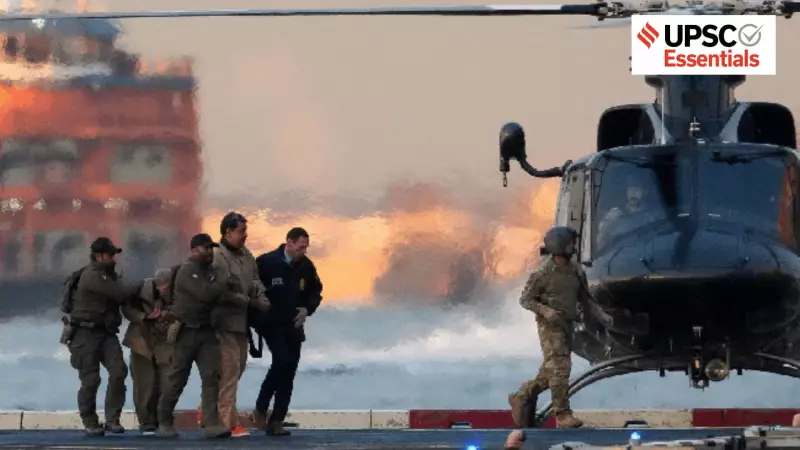
The unilateral military strike by the United States against Venezuela, leading to the capture of President Nicolas Maduro, has ignited a fierce global debate on the very foundations of the post-World War II international system. Codenamed 'Operation Absolute Resolve', this action is widely perceived as a direct assault on the Rules-Based International Order (RBIO) established to prevent the horrors of unchecked power politics.
What is the Rules-Based International Order?
The framework, often called the liberal international order, was institutionalized after 1945, primarily through the United Nations Charter. It was designed to move beyond traditional power politics by enshrining principles of state sovereignty, self-determination, multilateral cooperation, and the prohibition of unilateral force. Key institutions like the UN, World Bank, WTO, and IMF were created to provide a stable platform for international interaction.
Central to this order is the UN Charter. Article 1 mandates the UN to maintain international peace and security, while Article 2 explicitly requires member states to refrain from the threat or use of force in their international relations. The recent US operation in Venezuela flagrantly contravenes these core tenets, as the Trump Administration neither sought a mandate from the UN Security Council nor could claim an imminent threat justifying self-defense under Article 51.

A Return to Spheres of Influence?
President Trump's framing of the operation as an update to the Monroe Doctrine—dubbed the 'Donroe Doctrine'—signals a potential revival of 19th-century imperialist concepts where great powers exercise dominance over designated geographic spheres. This move to cement American influence in Latin America raises alarming questions about the regression of global norms and the weakening of multilateral safeguards.
Furthermore, the lack of a plausible legal justification for the strike, coupled with other actions like the expressed interest in acquiring Greenland, casts a long shadow over global stability. It also sets a dangerous precedent that could negatively impact the perception of conflicts in regions like Gaza and Ukraine.
A 'Worthless' Security Council and the Future of Global Order
The inability of the United Nations Security Council to hold the US accountable—primarily due to the American veto power—has led to severe criticism. As noted by Geoffrey Robertson KC, a former president of the UN war crimes court for Sierra Leone, this impunity renders the Security Council a 'worthless body' in such scenarios.
This crisis forces a urgent re-evaluation. Scholars like Andrew Heywood and Ben Whitham, in their work 'Global Politics', prompt us to ask: how far do recent geopolitical shifts threaten the rules-based order these international organizations were built to uphold? The Venezuela strike is not an isolated incident but a symptom of deeper geopolitical realignments that challenge the very architecture of post-1945 global governance.
The world now confronts a critical juncture. The debate triggered by the events in Venezuela goes beyond a single military intervention; it questions whether the foundational rules that have prevented large-scale interstate war for decades can survive in an era of resurgent unilateralism and great power competition.