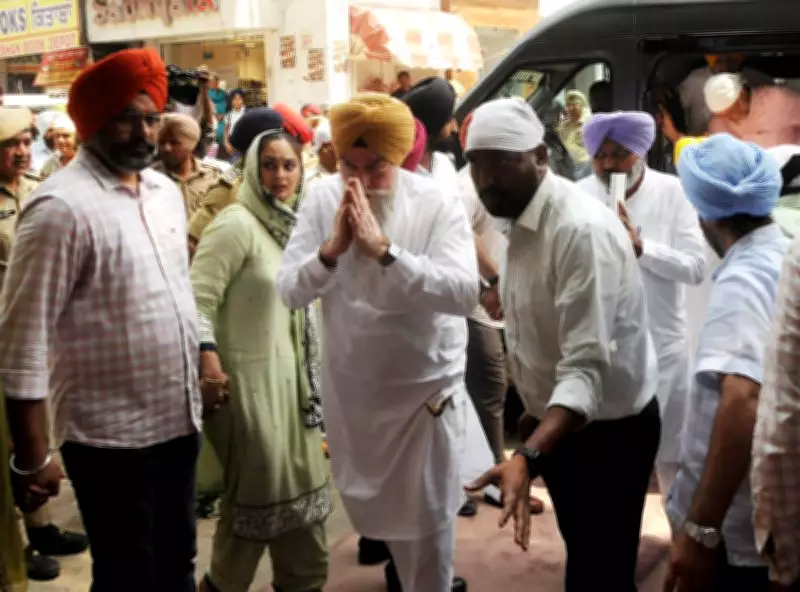
Sandhwan Appears Before Akal Takht Over SGGS Amendment Act
Punjab Vidhan Sabha Speaker Kultar Singh Sandhwan appeared before the Akal Takht on Monday, June 29, 2026, in response to a summons from officiating Jathedar Giani Kuldeep Singh Gargaj. The summons was issued in connection with the Jaagat Jot Sri Guru Granth Sahib Satkar (Amendment) Act. Sandhwan led a delegation of all Sikh AAP legislators and ministers from the state to the highest temporal seat of Sikhism.
Second Instance of Same Family Summoned
Sandhwan’s appearance marks only the second time in Sikh history that two members of the same family have been summoned by the Akal Takht. The first instance involved Giani Zail Singh, who served as President of India and Supreme Commander of the Indian armed forces. In the aftermath of Operation Bluestar in June 1984, Zail Singh was summoned by the Akal Takht, which held him morally accountable for the military action at the Golden Temple. Sandhwan is often mistakenly identified as Zail Singh’s grandson but is actually the grandson of Zail Singh’s brother, Jangir Singh. Approximately 42 years after Zail Singh’s summons, Sandhwan stood before the Jathedar on Monday.
Precedent Involving Badal Family
Before the Sandhwan family, only the Badal family had witnessed a similar precedent. In 1978, following a violent clash between Sikhs and the Nirankaris in Amritsar, then Chief Minister Parkash Singh Badal was summoned by the Akal Takht. In 2024, his son Sukhbir Singh Badal, the former Deputy Chief Minister, was declared “tankhaiya” (guilty of religious misconduct) and pronounced ‘tankhah’ (religious punishment) in connection with sacrilege cases and other anti-Panthic decisions taken during the SAD regime between 2007 and 2017.

Religious Punishment Norms Explained
Prof Kuldip Singh (retd), political science, Guru Nanak Dev University (GNDU), said the Akal Takht Jathedar could not impose legal actions such as fine or imprisonment. However, the Takht follows its own established norms for delivering religious punishment. “The Jathedar can excommunicate individuals, declare them 'tankhaiya' (punish for moral misconduct) and assign tankhah (religious punishment for atonement). This punishment may include ‘sewa’, such as cleaning of shoes and utensils, and offering nominal ‘bheta’ for conducting prayers. On certain occasions, the Jathedar may also direct the individual to wear a placard of repentance around the neck, as was recently seen in the case of Sukhbir Singh Badal and his group of ministers, who were held guilty of anti-Panthic decisions. Earlier, former Chief Minister Surjit Singh Barnala faced a similar situation when he was held accountable for deploying police inside the Golden Temple complex during Operation Black Thunder in 1986,” he said.
Political Motivation Alleged
Dr Amarjit Singh, director, Sikh Studies Chair, GNDU, said summoning a CM or Sikh MLAs at Akal Takht was nothing but a politically motivated move. Technically, he added, the Akal Takht cannot punish the Chief Minister, as he is neither ‘sabat surat’ (maintaining the full Sikh identity) nor in compliance with the Sikh code of conduct. Most recently, CM Mann was also summoned by Giani Gargaj over a controversial video. He was declared ‘Guru Dokhi’ (anti-Guru) “Panth Dokhi” (a betrayer of the Panth).