Hyderabad's Public Transport in Crisis: Low Ridership and Shrinking Services Amid Rapid Growth
Hyderabad may proudly wear its global-city badge, but when it comes to public transportation, the city is firmly stuck in the slow lane. Despite ranking among India's fastest-growing metropolises, Hyderabad is lagging far behind in public transport capacity and reliability, forcing a vast majority of its residents to depend on personal vehicles for daily commutes.
Alarming Imbalance in Commuter Patterns
Barely 30% of commuters in Hyderabad utilize public transport, while the remaining 70% rely on two-wheelers and cars. This stands in stark contrast to cities like Delhi and Mumbai, where public transport accounts for over 50% of daily trips. This severe imbalance has directly fueled rising traffic congestion and significantly longer commute times across the city.
MMTS: From Backbone to Backseat
Hyderabad's suburban rail system, the Multi-Modal Transport System (MMTS), was once projected as a game-changer for daily commuters. However, it is now operating at just 25% of its pre-pandemic capacity, making it one of the weakest suburban rail networks in the country.

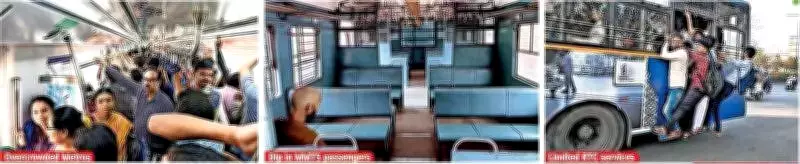
Daily MMTS ridership has plummeted from 1.6 lakh passengers in 2019 to a mere 45,000 today. In response to declining patronage, the South Central Railway (SCR) has cut daily services from 121 to 81, despite a few services being added under phase II. When compared to other metropolitan cities, Hyderabad's suburban rail usage is negligible.
- Mumbai's local trains carry between 60 and 70 lakh passengers every day.
- Kolkata's suburban rail network serves over 35 lakh commuters daily.
- Chennai handles at least 20 lakh passengers each day.
Hyderabad's numbers do not even reach 10% of these figures. Moreover, the SCR is currently operating nearly 10 times fewer suburban services compared to other metros, where more than 1,000 local train services run daily, highlighting the scale of underutilization and missed potential.
Commuters cite irregular schedules, frequent delays, prolonged halts between stations, and last-minute cancellations as key reasons for abandoning MMTS. Many stations also lack proper access roads, parking, feeder services, and safety infrastructure, further discouraging usage.
P Bharadwaj of the Suburban Trains and Bus Travellers Association explained, "One of the major reasons is that SCR stopped MMTS services between 10 am and 4 pm on the Hyderabad–Lingampally and Secunderabad–Lingampally routes. Moreover, between Charlapally and Hi-Tec City, there is just one service. Even in the 2026 timetable, no additional MMTS services have been added."
SCR officials attribute the drop in ridership to commuters shifting to Metro services and women opting for free RTC bus travel. A senior official in SCR stated, "Operational constraints, including delays in procuring new rakes under MMTS Phase-II, have become a setback for improving suburban connectivity. For phase-II, the State government must contribute Rs 760 crore, but only Rs 379 crore has been deposited so far, thereby slowing infrastructure upgrades and expansion."
Bus Services Shrinking When Demand Is Rising
Hyderabad's bus network presents an equally grim picture. According to national urban transport benchmarks, cities with a population exceeding one million should operate 40–60 buses per one lakh population. By this standard, Hyderabad should have 5,000 to 7,500 buses on the road.
Instead, the Telangana State Road Transport Corporation (TGSRTC) operates less than 3,000 buses, down sharply from 3,800 buses a decade ago—even as the city's population and urban sprawl have expanded significantly. In contrast, Bengaluru, one of the most congested cities in the country, has over 7,000 city buses.
Experts warn that reduced fleet strength has led to longer waiting times, overcrowded buses, skipped services, and poor route coverage, particularly in newly developed IT corridors and peripheral areas.
TS Reddy, transport planning expert and former Scientist-G at the Central Road Research Institute, emphasized, "Reducing bus services is the worst possible response to congestion. When buses disappear, people don't stop travelling—they buy vehicles."

A senior TGSRTC official noted, "Tackling last-mile connectivity is a priority. Shuttle services from Metro stations to IT hubs will help commuters complete their journeys without switching to private transport."
To improve public transport connectivity, TGSRTC is planning to introduce shuttle bus services from Metro stations to key destinations in the IT corridor, where thousands of commuters currently depend on autos and cabs after exiting metro stations.
Y Nagi Reddy, TGSRTC MD, told TOI, "We will be ramping up our fleet strength. While the current operational fleet stands at over 3,000 buses, including 375 buses added in 2025, the total fleet is expected to touch 4,000 buses by the end of this year, with a strong focus on electric mobility. As part of this expansion, 170 electric buses will be inducted in February. Additionally, under the PM e-Drive scheme, Hyderabad is set to receive a larger batch of electric buses from August. With these additions, we are confident of catering to nearly 30 lakh RTC ridership daily."
Apart from increasing fleet strength, TGSRTC is also expanding its route coverage to underserved residential areas. Nagi Reddy added that 373 new colony services were introduced last month, improving connectivity for nearly 7.5 lakh residents across various parts of the city, with more colony services planned this month as well.
Metro Success, But Not Sufficient
While the Hyderabad Metro Rail (HMR) has seen steady ridership growth, it remains overcrowded during peak hours, and its reach is limited to select corridors.
At present, HMR records an average daily ridership of around 4.5 to 5 lakh passengers, operating a fleet of 57 three-coach trains across its corridors. With passenger numbers steadily rising, especially during office hours, commuters frequently face packed coaches and platform congestion.
To address the growing rush, HMR is planning to augment its stock by adding over 50 additional coaches. The move is aimed at increasing train capacity and easing peak-hour congestion. However, officials said that the proposal is still at a preliminary discussion stage, and once the procurement process is initiated, it could take a couple of years for the new coaches to be delivered and commissioned.