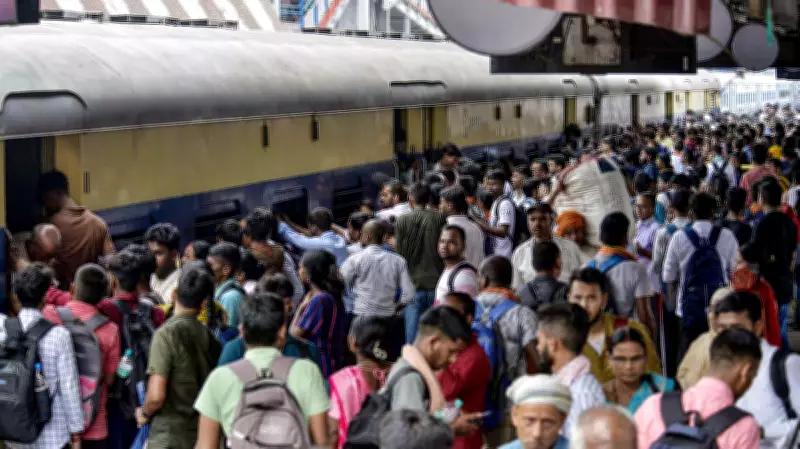
Scenes of extreme overcrowding on Indian trains have become increasingly common, with students, government job aspirants, and migrant labourers forced to travel in packed coaches without a seat, often squatting on the floor, in doorways, and even inside toilets. This crisis, reported by ETB Sivapriyan on June 28, 2026, highlights the severe capacity constraints on the country's rail network.
Daily Struggle for a Berth
Millions of Indians rely on the railway system for long-distance travel, but the demand far exceeds supply. On many routes, passengers are left with no choice but to endure journeys of 12 hours or more standing in cramped conditions. The problem is particularly acute on trains connecting major cities to smaller towns and rural areas, where migrant labourers and job seekers form a large portion of travelers.
According to railway officials, the average occupancy on some popular routes exceeds 150% during peak seasons, leading to dangerous overcrowding. In 2025, the Indian Railways reported carrying over 8 billion passengers, but the number of coaches has not kept pace with population growth and economic migration.

Impact on Passengers
Passengers recount harrowing experiences. "I had to stand for 14 hours from Bihar to Delhi, squeezed between strangers. There was no room to sit, and the toilet was occupied by three people," said Ramesh Kumar, a migrant worker traveling to find employment. Such stories are echoed across the network, with women and elderly passengers particularly vulnerable to harassment and health risks.
The overcrowding also leads to frequent delays and accidents. In 2025, over 100 people died in train-related incidents, many due to falling from overcrowded coaches or being hit by trains while crossing tracks.
Government Response and Infrastructure Gaps
The Ministry of Railways has acknowledged the crisis but cites budget constraints and slow infrastructure development as key hurdles. "We are adding new coaches and upgrading stations, but demand is growing faster than our capacity," said a ministry spokesperson. The government has launched initiatives like the 'Mission Raftaar' to increase train speeds and the 'Kavach' safety system, but critics argue these do not address the immediate need for more seats.
Railway experts point to the need for a massive expansion of the network, including dedicated freight corridors to free up passenger lines, and investment in high-speed rail. However, the current budget allocation of ₹2.5 lakh crore for 2026-27 is seen as insufficient to meet the target of doubling passenger capacity by 2030.
Social and Economic Consequences
The capacity crisis has broader implications. Students from rural areas, who travel to cities for competitive exams, often arrive exhausted and perform poorly. Migrant workers, who form the backbone of urban economies, face increased costs and health issues due to stressful travel. The situation also fuels social unrest, as seen in protests in Bihar and Uttar Pradesh demanding better railway services.
"The railways are the lifeline of India's economy, but they are failing the common man," said Dr. Anjali Sharma, a transport economist at the Indian Institute of Technology. She emphasized that without urgent investment, the crisis will worsen as the population grows and urbanization accelerates.
Looking Ahead
As of June 2026, the Indian Railways continues to operate with a fleet of over 70,000 coaches, but the average age of coaches is 15 years, and many are outdated. The introduction of new 'Vande Bharat' sleeper trains and 'Amrit Bharat' services has provided some relief, but these cover only a fraction of routes. The government plans to induct 10,000 new coaches by 2027, but experts say this is a drop in the ocean.
For now, millions of Indians continue to fight for a berth, their dignity compromised in the cramped corridors of the nation's trains.