

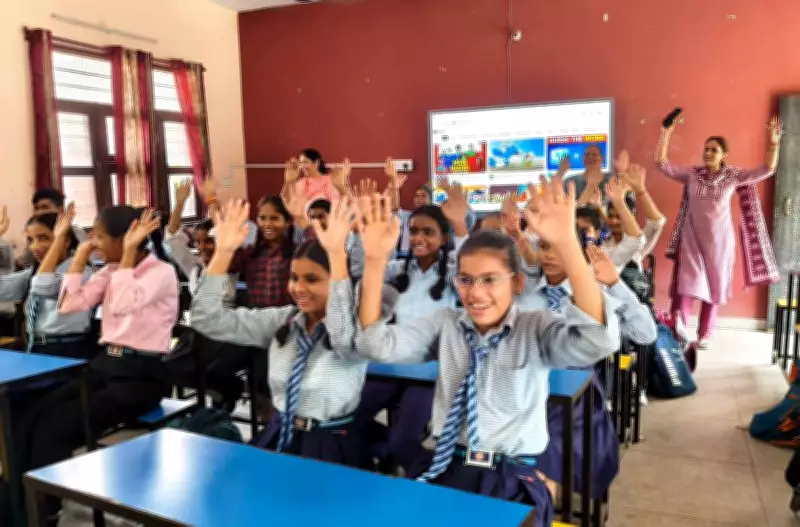
Punjab has emerged as a top-performing state in school education, according to the NITI Aayog's 2026 report, "School Education System in India: Temporal Analysis and Policy Roadmap for Quality Enhancement." The state's dramatic rise from 22nd place in the Performance Grading Index (PGI) in 2017 to the top rank in PGI 2.0 (2025) demonstrates that sustained investment in infrastructure, teacher accountability, and student support systems can transform public education.
NITI Aayog report shifts focus from access to quality
India's school education system, with over 14.71 lakh schools and 24.69 crore students, has achieved near-universal primary enrolment. However, the Gross Enrolment Ratio at the higher secondary stage remains only 58.4%, indicating major continuity gaps. The NITI Aayog report argues that the challenge is no longer just schooling but meaningful learning, institutional capacity, and systemic transformation. Punjab's experience offers a replicable model for other states.
Punjab's measurable improvements across indicators
Punjab's reforms addressed governance, infrastructure, and learning outcomes simultaneously. The state invested in smart schools, digital learning platforms like the Punjab Educare App, and leadership training for principals and teachers. These efforts benefited nearly 25 lakh students, especially during and after the Covid-19 pandemic. According to the NITI Aayog report, Punjab achieved the highest grade (Prachesta 1) in the revamped PGI 2.0, reflecting structural and sustained improvements across government regimes.

Lessons for national education reform
The report emphasizes that educational transformation requires moving beyond enrolment statistics to focus on learning outcomes, school leadership, and teacher capacity. Punjab's progress challenges the assumption that government schools cannot deliver quality education. Key reforms included structured leadership development, decentralized empowerment, and stronger academic support systems. As India aims for Viksit Bharat 2047, the quality of school education will be critical. Punjab's cautious optimism shows that with political, administrative, and institutional commitment, public education systems can improve substantially.






