

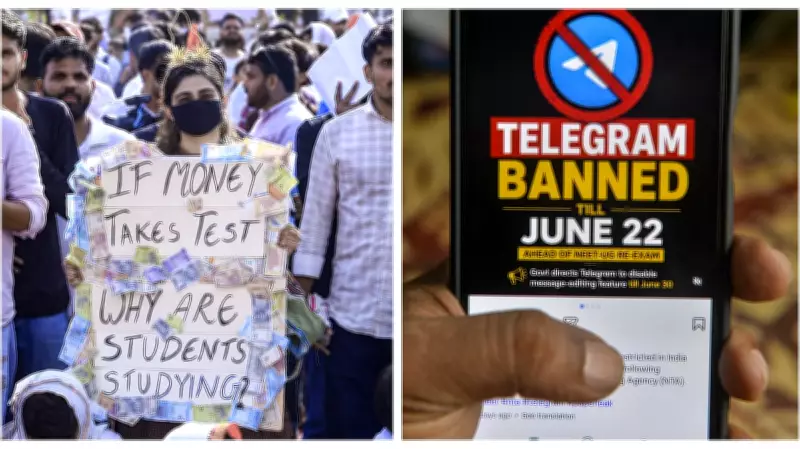
The Delhi High Court on Thursday dismissed a plea by messaging platform Telegram challenging a temporary ban imposed on its services in India, ahead of the upcoming NEET re-examination. The court observed that the temporary restriction was necessary to maintain the integrity of the examination process.
Court Upholds Temporary Ban
Justice Subramonium Prasad, presiding over the case, stated that the court was satisfied that the measure of temporarily blocking public access to Telegram could not be held as disproportionate. The platform, which has its registered office in Dubai, United Arab Emirates, had argued that the ban infringed upon the rights of its users and the company.
Background of the Ban
The government had ordered internet service providers to block Telegram in India following concerns that the platform was being used to leak question papers and facilitate cheating in the NEET UG 2026 examination. The re-test was ordered after irregularities were detected in the original exam held earlier this year.

Key Points from the Judgment
- The court emphasized that the temporary ban was a necessary step to ensure a fair examination process for millions of students.
- Telegram's plea argued that the ban was arbitrary and violated principles of natural justice, but the court found the government's actions reasonable given the circumstances.
- The judge noted that the ban would remain in effect until the conclusion of the NEET re-test, scheduled for July 2026.
Reactions and Implications
Legal experts have weighed in on the decision, with many supporting the court's stance. "The integrity of high-stakes examinations like NEET is paramount. Temporary measures, though disruptive, are sometimes necessary to prevent systemic cheating," said senior advocate Rajiv Dhavan.
Telegram, which has over 500 million users globally, including a significant user base in India, expressed disappointment with the ruling. The company stated that it would explore all legal options, including a potential appeal to the Supreme Court.
Government's Stand
The Ministry of Electronics and Information Technology (MeitY) defended the ban, citing Section 69A of the Information Technology Act, which allows the government to block public access to any intermediary in the interest of public order or security. Officials argued that the leak of question papers on Telegram posed a direct threat to the fairness of the examination.
The NEET re-test is expected to be conducted in a highly secure environment, with multiple layers of surveillance and anti-cheating measures in place. The ban on Telegram is one of several steps taken by the government to prevent any further irregularities.
As the legal battle continues, students and parents await the outcome, hoping for a smooth and transparent examination process.






