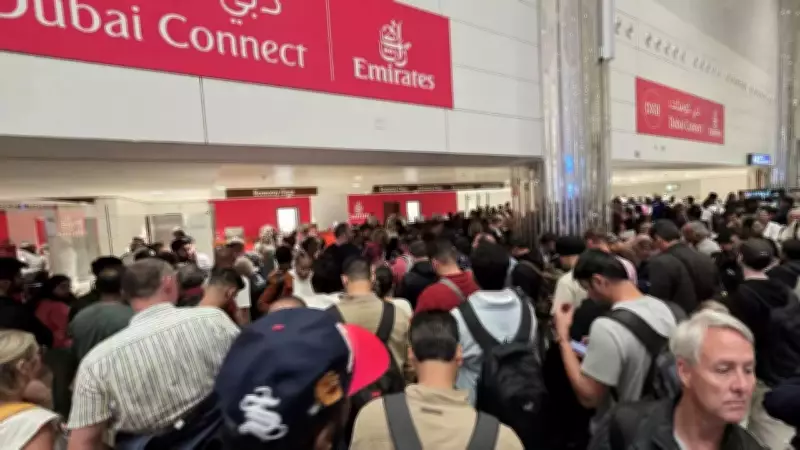
Dubai Airports Suspend All Flight Operations Amid Escalating Middle East Conflict
In a significant development impacting global aviation, all flight operations at Dubai International Airport (DXB) and Dubai World Central–Al Maktoum International Airport (DWC) were completely suspended on Saturday. This unprecedented move comes as direct consequence of the rapidly escalating military conflict between Israel and Iran, which has triggered widespread airspace closures across the Middle East region.
Airport Authorities Issue Official Travel Advisory
The airport authorities made the formal announcement through their official social media channel, stating clearly: "Flight operations at DXB and Dubai World Central – Al Maktoum International have been suspended until further notice." The advisory strongly recommended that passengers avoid traveling to the airport entirely and instead contact their respective airlines directly for the latest flight status updates and rescheduling options.
The airport management expressed appreciation for passenger cooperation during this challenging situation, adding that "further updates will be provided as we continue to monitor the developing circumstances closely." This suspension represents one of the most significant disruptions to aviation in the region's recent history, affecting one of the world's busiest international travel hubs.

Widespread Aviation Disruption Across Multiple Countries
The aviation crisis extends far beyond Dubai's airports, creating a domino effect of travel disruptions throughout the Middle East. Multiple nations including Israel, Iran, Iraq, and others have implemented complete or partial airspace closures in response to the military hostilities. This has forced airlines to undertake massive operational adjustments, including:
- Complete cancellation of numerous scheduled flights
- Emergency diversion of aircraft already in transit
- Extensive rerouting of flight paths to avoid conflict zones
- Suspension of services to entire regions
Dubai-based carrier flydubai confirmed that several of their flights had been directly affected due to the temporary closure of airspace over Iraq, Iran, and Israel. The airline is working to minimize passenger inconvenience while prioritizing safety above all other considerations.
Major Airlines Implement Comprehensive Flight Suspensions
India's national carrier Air India took decisive action in response to the deteriorating security situation. The airline issued an official statement explaining: "In view of the developing situation in parts of the Middle East, all Air India flights to all destinations in the Middle East have been suspended." The airline emphasized its unwavering commitment to maintaining the highest possible safety standards for both passengers and crew members during this period of heightened risk.
Air India Express, the budget subsidiary of Air India, followed with its own announcement: "Air India Express has suspended all west-bound international flights. The safety and security of our guests and crew remain our highest priority." This comprehensive suspension affects numerous routes and thousands of passengers, with airlines across the globe reassessing their Middle Eastern operations.
Military Conflict Triggers Aviation Crisis
The aviation disruptions stem directly from escalating military actions that began on Saturday. The United States and Israel initiated what has been described as "major combat operations" targeting locations within Iran. This offensive prompted immediate retaliation from Iranian forces, who launched coordinated strikes against American military installations throughout the Middle East under an operation codenamed "Truthful Promise 4."
According to statements from Iran's Revolutionary Guard, the retaliatory strikes specifically targeted:

- The United States Fifth Fleet headquarters located in Bahrain
- American military bases in Qatar and the United Arab Emirates
- Various strategic military sites within Israel itself
These military exchanges occurred mere hours after joint United States-Israel airstrikes reportedly hit targets in Tehran, marking a significant escalation in regional tensions that has now directly impacted civilian aviation on an unprecedented scale. The situation remains fluid, with aviation authorities worldwide closely monitoring developments that could affect flight safety across multiple regions.