Congress Launches Sharp Attack on PM Modi's Interview as 'Desperate PR Exercise'
The Congress party on Sunday delivered a scathing response to Prime Minister Narendra Modi's recent interview with news agency PTI, branding it a "carefully scripted and desperate PR exercise" designed to divert public attention from pressing national issues. The political confrontation has intensified as both sides exchange heated rhetoric ahead of crucial parliamentary sessions.
Congress Alleges Strategic Timing to Counter Budget Criticism
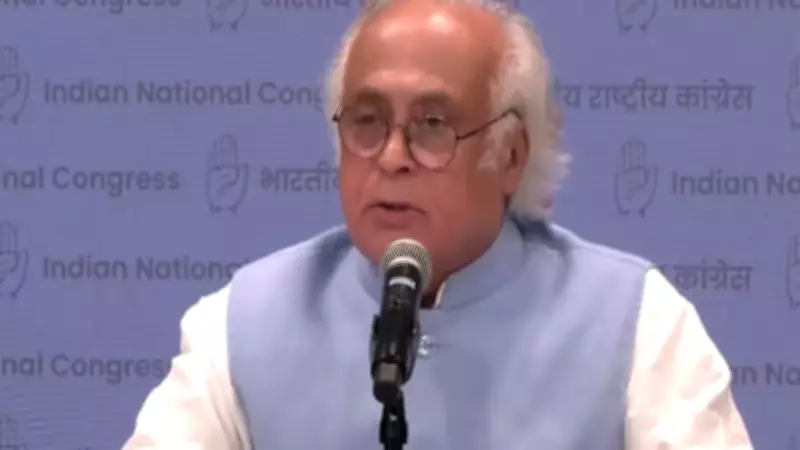
Senior Congress leader Jairam Ramesh articulated the party's position, asserting that the interview's timing was deliberately orchestrated to deflect criticism surrounding the Union Budget and opposition attacks in Parliament. "The Prime Minister recognizes that this year's Budget has been a complete disappointment, demonstrating clear intellectual exhaustion," Ramesh stated in a detailed post on social media platform X.
He elaborated further, noting, "Financial markets have responded negatively, and investors remain unimpressed with the government's economic direction. Consequently, the Prime Minister felt compelled to grant this interview two weeks after the Budget presentation, following its thorough dismantling by opposition parties in parliamentary debates." Ramesh dismissed the interview's content as containing "characteristic Modi-style one-liners that hold little substantive meaning in practical reality."

Accusations of Narrative Shifting Amid Policy Pressures
The Congress leader leveled serious allegations that Prime Minister Modi is facing mounting pressure regarding the trade agreement with the United States and unresolved farmers' issues, prompting what he described as a tactical media diversion. "Under sustained siege due to his perceived surrender to American demands in trade negotiations, the Prime Minister has reverted to his preferred strategy of headline management," Ramesh declared.
He continued with heightened criticism, stating, "This calculated media appearance aims to redirect attention away from what we view as betrayal of countless farmers and other policy capitulations. The so-called interview lacks journalistic integrity, representing instead a meticulously prepared and frantic public relations maneuver." Ramesh reinforced his point in Hindi, adding, "Pradhan Mantri jhuke bhi hain aur thake bhi hain," suggesting the Prime Minister appears both bowed and fatigued under current pressures.
PM Modi's Vision for Economic Transformation and Digital Leadership
In his comprehensive interview with PTI, Prime Minister Modi presented a contrasting vision, emphasizing the private sector's pivotal role in driving India's next phase of economic advancement. He firmly asserted that reform implementation has remained a fundamental commitment of his administration "both in letter and spirit," rejecting opposition characterizations of policy stagnation.
The Prime Minister articulated that achieving "Viksit Bharat" (Developed India) will require bold industrial investments in innovation, long-term capacity building, and enhanced global competitiveness. Regarding the recently presented Union Budget, Modi characterized it not as a "now or never moment" born from external compulsion, but rather as a "we are ready" moment emerging from thorough preparation and national inspiration.
He maintained that the budget reflects India's collective aspiration to transform into a developed nation, clarifying that none of his government's budgetary documents have been prepared with a routine "bahi khata" (account book) mentality, but rather with strategic vision.
Digital Infrastructure and Defense Modernization Priorities
Highlighting significant achievements, Prime Minister Modi pointed to India's emergence as a global digital leader, crediting transformative reforms in transaction systems through the Unified Payments Interface (UPI) platform. He projected that data centers would become massive employment generators in the coming years, fueling technological employment growth.
The Prime Minister also underscored what he described as the most expansive infrastructure development initiative in India's history, while emphasizing unwavering governmental commitment to supporting and modernizing defense forces through necessary investments and policy frameworks.

Contrast with Previous Administration and Governance Philosophy
In a pointed comparison, PM Modi criticized the previous United Progressive Alliance (UPA) government's track record, alleging that during their tenure, negotiations would frequently commence only to collapse without substantive outcomes, despite prolonged discussions. He contrasted this with his administration's approach, asserting that political stability and policy predictability have successfully restored investor confidence in India's economic landscape.
Concluding his interview remarks, the Prime Minister affirmed that women's welfare guides every decision-making process within his government, positioning this as a cornerstone of his governance philosophy moving forward.