

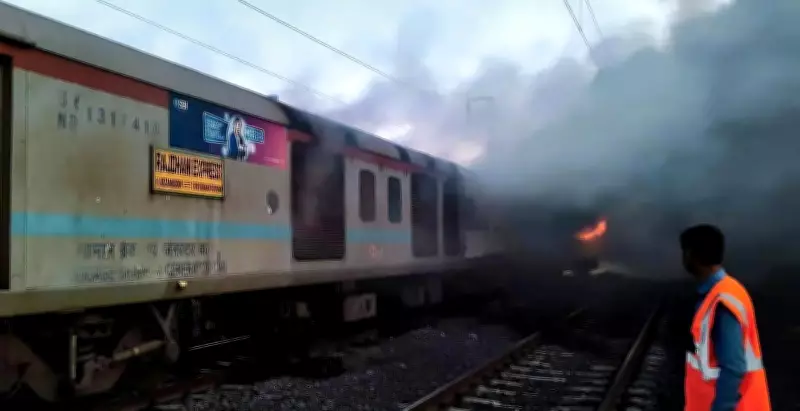
A fire that broke out on the Thiruvananthapuram-Hazrat Nizamuddin Rajdhani Express in Ratlam, Madhya Pradesh, on Sunday has once again brought into focus the preparedness of Delhi's railway stations to handle onboard fire emergencies, particularly when a train is stationed deep within a crowded platform or stranded between stations.
Delhi's Major Railway Hubs
Delhi's four primary train hubs — New Delhi Railway Station, Old Delhi Railway Station, Hazrat Nizamuddin Railway Station, and Anand Vihar Terminal — collectively manage the majority of long-distance train operations in the national capital. Officials stated that while fire incidents on platforms are largely controllable, operational challenges remain significant at older stations that were constructed without modern emergency access planning.
Past Incidents Highlight Vulnerabilities
Senior railway officials recalled a 2019 fire at New Delhi Railway Station, where a rear power car and luggage van of the Chandigarh-Kochuveli Express caught fire on platform 8 due to a short circuit. Although all passengers were evacuated and no casualties were reported, the incident exposed logistical weaknesses in the station's infrastructure. Firefighting officials noted that fire tenders could not directly access the platform due to the station's layout. Vehicles had to be positioned at a distance, compelling firefighters to use longer hoses through station concourses and crowded entry points before water could reach the burning coach. The operation was further complicated as the blaze originated in the generator car and spread to a luggage van carrying parcels. Firefighters had to navigate around electrified overhead equipment lines while managing heavy passenger movement across adjoining platforms during peak hours. Delhi Fire Services deployed 12 fire tenders in response.

Challenges in Firefighting at Middle Platforms
A senior fire department official explained that firefighting becomes more difficult when a fire occurs on platforms in the middle of a station, rather than at the edges such as platforms 1 or 16 at New Delhi. “If the incident is somewhere in between, hose deployment itself consumes crucial time. Ideally, hydrant systems should be installed closer to the middle platforms so that firefighters can immediately plug in and begin operations,” the official said. Officials added that the Anand Vihar Terminal, being relatively newer, offers better emergency vehicle access to platforms.
Grave Danger During Moving Trains
The gravest danger, however, arises when a train is moving and catches fire. “Wind speed acts like a continuous oxygen supply and can intensify the fire rapidly,” a fire official warned. Northern Railway officials stated that onboard staff are trained to respond quickly in such emergencies. “Our staff are trained to use extinguishers and detach coaches to prevent the spread of fire,” a senior official said. In the Ratlam Rajdhani incident, railway officials noted that the assistant operations manager of Lucknow division, Rashida Khatoon, who was travelling as a passenger, and a train guard acted as first responders and helped detach the affected coach from the rake before the fire could spread.
Structural Issues and Material Vulnerability
Fire officials also pointed to a structural issue that poses a challenge during train fires. The materials used inside conventional railway coaches have “higher fire vulnerability compared to systems like Delhi Metro, where non-combustible materials are extensively used,” an official said. Cables and interior fittings should be made more fire-resistant to mitigate risks.

Accessibility Challenges at Nizamuddin and Old Delhi
Among Delhi's stations, officials highlighted that Hazrat Nizamuddin and Old Delhi face added challenges due to encroachment and severe congestion around approach roads. Unauthorised parking by auto-rickshaws, street vendors, and traffic bottlenecks often slow emergency vehicle movement, particularly near the Sarai Kale Khan side of Nizamuddin station. The intense congestion around the station, including haphazard auto-rickshaw parking, idle buses, roadside vendors, and encroachments along Mathura Road, frequently narrows access for emergency vehicles. Fire officials said that during peak hours, even reaching the station can become difficult. “The biggest concern at Nizamuddin is accessibility. Even if the internal response mechanism is ready, delays in vehicle movement outside the station can impact response time,” an official said. Dense commercial activity around the station also creates an evacuation problem.
Recent Safety Measures
A Northern Railway official noted that a fire safety system in the Rajdhani coach was activated on May 17, leading to an automatic application of brakes. A safety audit has been initiated following the incident.





