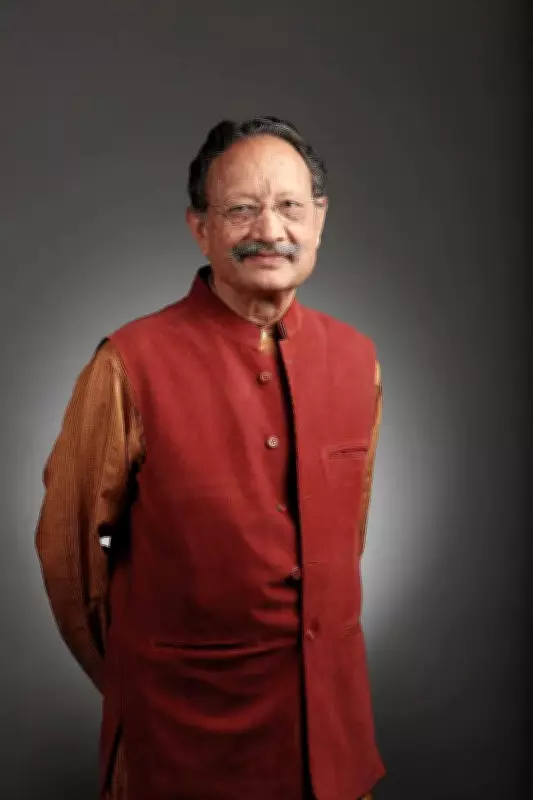
Dehradun: Former Uttarakhand chief minister and BJP stalwart Major General (retd) Bhuwan Chandra Khanduri passed away at a private hospital here at 11:10 am on Tuesday following a prolonged illness. He was 91.
Born on October 1, 1934, Khanduri is survived by his wife Aruna, daughter Ritu Khanduri Bhushan (the current Speaker of the Uttarakhand assembly), and son Manish, who contested the Pauri Lok Sabha seat in 2019.
As a mark of respect, the Uttarakhand government announced a three-day state mourning. The funeral will be held with full state honors in Haridwar on Wednesday.

Military Career
Before entering politics, Khanduri served in the Corps of Engineers of the Indian Army from 1954 to 1991. During his illustrious military career, he contributed to the nation’s defense in three historic conflicts – the 1962 Indo-China war, the 1965 Indo-Pak war, and the 1971 Indo-Pak war.
During the 1971 war, he displayed exceptional leadership and strategic competence as the commander of an Engineer Regiment in the Samba sector of Jammu and Kashmir.
Throughout his military tenure, he held several key appointments, including director of management studies at Army Headquarters, commander of an Engineer Brigade at Meerut, and chief engineer in the Siliguri region of West Bengal. He also served as deputy and additional military secretary and as additional director general in the Engineer-in-Chief Branch.
In recognition of his distinguished service, the Government of India conferred upon him the Ati Vishisht Seva Medal (AVSM) on January 26, 1982. He retired as a Major General in 1991.
Political Journey
Khanduri entered public life in 1991 and was elected to the Lok Sabha from the Pauri seat on a BJP ticket that same year. He went on to represent the constituency multiple times, winning re-elections in 1998, 1999, 2004, and 2014.
As a parliamentarian, he contributed significantly to various standing committees, including finance, defence, home, petroleum, and public accounts. Notably, he chaired the parliamentary standing committee on finance from August 2004 to March 2007.
In the Union cabinet of Prime Minister Atal Bihari Vajpayee, Khanduri earned widespread acclaim for transforming India’s infrastructure. Appointed minister of state (independent charge) for road transport and highways on November 7, 2000, he was elevated to cabinet rank on May 24, 2003, serving until May 21, 2004. During this term, he played a pivotal role in accelerating major infrastructure projects, including the Golden Quadrilateral and the National Highway Development Project (NHDP). He briefly held the additional charge of the ministry of urban development in 2003.
Chief Minister of Uttarakhand
Khanduri was instrumental in strengthening the BJP's grassroots in Uttarakhand, leading the party to form its first elected government in the state in 2007. Though he was Uttarakhand’s fourth chief minister – following Nityanand Swami, B S Koshyari, and N D Tiwari – he was the BJP’s first elected chief minister.
Khanduri served two terms as chief minister: from March 7, 2007, to June 27, 2009, and from September 11, 2011, to March 13, 2012.
Following the BJP’s loss of all five Lok Sabha seats in 2009, he was replaced by Ramesh Pokhriyal ‘Nishank’. However, he was brought back to the helm months before the 2012 assembly elections. Despite campaigning under the popular slogan “Khanduri Hai Zarori” (Khanduri is necessary), he suffered a personal defeat in the Kotdwar seat. The BJP secured 31 seats to the Congress’s 32, allowing the latter to form the government.
During his governance, Khanduri was widely respected for championing anti-corruption initiatives and advancing a robust Lokayukta system in the state.
Tributes Pour In
As the news of Khanduri’s demise spread, President Droupadi Murmu described his passing as “extremely heartbreaking,” stating that Khanduri set a benchmark for “honest, simple, transparent, and development-oriented politics.”
Vice President C P Radhakrishnan said the nation had lost a distinguished soldier, able administrator, and a statesman of rare integrity, recalling Khanduri’s visionary role in shaping India’s highway infrastructure.

Prime Minister Narendra Modi commended Khanduri’s invaluable contributions to both the armed forces and public life, noting that the former chief minister worked tirelessly to improve nationwide connectivity.
Union Home Minister Amit Shah termed his demise an “irreparable loss” for the BJP family and Uttarakhand, highlighting that Khanduri lived by the principle of “nation first.”
Chief Minister Pushkar Singh Dhami stated, “Khanduri ji presented an unparalleled example of national service, discipline and dedication... By taking numerous important decisions in the interest of the state, he provided a new direction to development.”
Former Chief Minister Harish Rawat expressed deep grief in a condolence message: “Khanduri ji was a personality of his own kind. As brilliant as he was as a soldier, he was equally remarkable as a person... Every tenure of his will be remembered for one good deed or another. He was a person without enemies.”
Remembering her father, Uttarakhand Assembly Speaker Ritu Khanduri Bhushan shared a poignant note: “I have not merely lost my father — I have bid farewell to the greatest pillar of my life, my guide and the personality in whose shadow I understood the meaning of duty, discipline, and service. The life of Major General (Retd.) Bhuvan Chandra Khanduri ji was not the story of a single individual, but a living saga of complete dedication to the nation. His life’s journey traversed the battlefields of the Indian Army to the highest platforms of democracy... yet in every role, his identity remained singular: Nation first.”