

IAF's Vayu Shakti 2026 Showcases Lethal Arsenal, Strategic Readiness at Pokhran
In the context of Operation Sindoor and a rapidly shifting global security environment, India is intensifying efforts to bolster its defence capabilities. The Indian Air Force (IAF) recently displayed an array of transformative weapons designed to decisively counter adversaries during Exercise Vayu Shakti at the Pokhran Field Firing Range. This day-and-night firepower demonstration, held with President Droupadi Murmu as Chief Guest, underscored India's position as one of the world's most formidable air forces.
From Inception to Execution: A Theme of Operational Precision
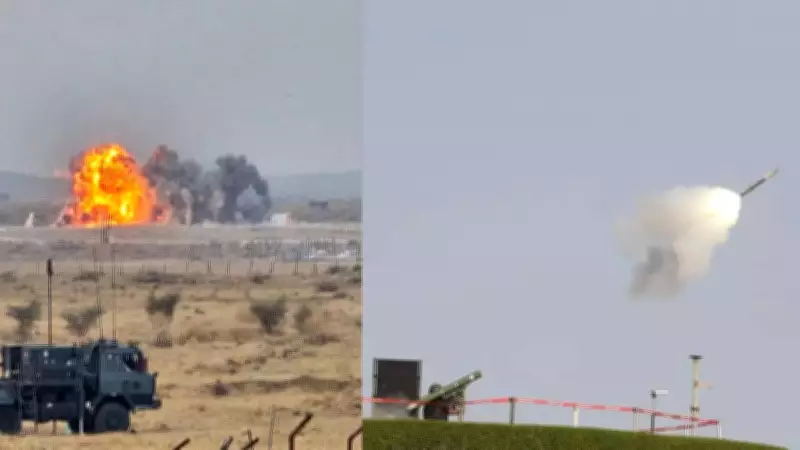
Conducted under the theme "From Inception to Execution," the exercise highlighted the IAF's proficiency in converting operational concepts into effective battlefield results. Fighter jets, attack helicopters, and missile systems like the Akash and SPYDER air defence systems engaged simulated enemy targets with remarkable accuracy, creating a vivid combat scenario at Pokhran. The coordinated strikes, marked by intense explosions and dust clouds, symbolized India's preparedness to address challenges on multiple fronts.
Dignitaries in attendance included Defence Minister Rajnath Singh, Union Minister Gajendra Singh Shekhawat, Rajasthan Governor Haribhau Bagade, Chief of Defence Staff Anil Chauhan, and Air Chief Marshal A. P. Singh, alongside Members of Parliament and foreign delegates from allied nations. With the international border located just 125 km from Jaisalmer, the display conveyed a potent strategic message beyond India's borders.

Massive Aerial Participation and Indigenous Systems
A total of 77 aircraft, comprising fighter jets, combat helicopters, and transport planes, operated from bases including Jaisalmer, Suratgarh, Jodhpur, Phalodi, Nal, and Uttarlai. These assets executed synchronized attacks on simulated targets such as enemy radar sites, troop concentrations, ammunition depots, and fuel installations.
- Frontline aircraft like the Rafale, Su-30MKI, MiG-29, Mirage 2000, and Jaguar delivered precision-guided munitions and conventional bombs with deadly accuracy. The Rafale produced a precisely timed sonic boom, while Jaguars conducted low-level reconnaissance to capture high-fidelity imagery.
- Transport and support aircraft, including the C-17, C-130J, IL-76, IL-78, AN-32, and Embraer platforms, demonstrated strategic airlift, mid-air refuelling, and logistics support. A C-17 performed a Containerised Delivery System drop, and a C-130J executed assault landings with the IAF's Garud Special Forces.
- The indigenous Light Combat Helicopter (LCH) 'Prachand' showcased its air-to-ground missile capabilities, and Mi-17 helicopters launched rocket attacks on ground targets. The Advanced Light Helicopter Mk-IV weaponised variant engaged in joint operations with the Indian Army.
In a notable first, Chinook helicopters airlifted M-777 Ultra-Light Howitzers in underslung mode, illustrating rapid deployment of combat assets. Indigenous air defence systems Akash and SPYDER successfully neutralized simulated aerial threats, emphasizing India's commitment to Atmanirbhar Bharat (self-reliant India).
Night Operations and Drone Spectacle
As darkness descended, night operations intensified with the Su-30MKI and Jaguar conducting strategic bombing missions, and the C-130J performing flare dispensing. A highlight of Vayu Shakti 2026 was a grand drone show—the first of its kind at the exercise—depicting India's map, Air Force formations, and historic operations such as the 1965 Sargodha strike, Kargil's Tiger Hill bombing, the Balakot air strike, and Operation Sindoor.
Within a span of three hours, approximately 120 tonnes of ordnance were delivered over a two-square-kilometre area, reflecting the IAF's immense destructive capability and pinpoint accuracy. Exercise Vayu Shakti 2026 ultimately served as a resounding testament to the Indian Air Force's operational preparedness, technological advancement, and unwavering resolve to safeguard the nation.






