

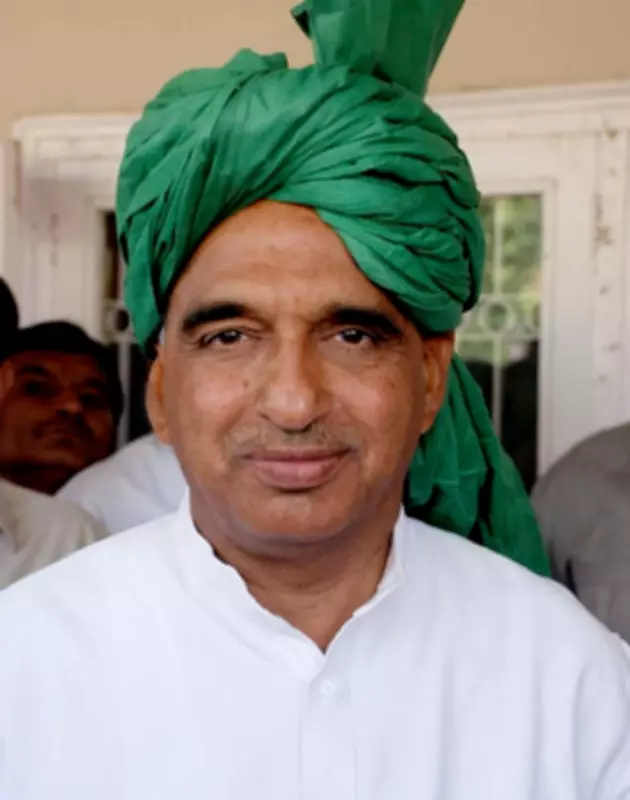
The Indian National Lok Dal (INLD) has strongly opposed the 1994 Yamuna water agreement between Haryana and Rajasthan, signed by the BJP government in Delhi, vowing to protect every drop of Haryana's lawful water share. Former Finance Minister and INLD national patron Sampat Singh made the party's stance clear during a press conference at the party headquarters in Chandigarh on Monday.
INLD accuses BJP of compromising Haryana's water rights
Singh alleged that just as the Congress party had earlier compromised on water issues to save its chair, the BJP government has now signed a similar agreement to give water to Rajasthan. He emphasized that INLD has always fought to protect Haryana's water rights and will not accept any compromise on its lawful share of Yamuna water. The construction of the Sutlej-Yamuna Link (SYL) canal remains incomplete despite repeated directions from the Supreme Court, causing continuous water shortages in Haryana.
Details of the 1994 Yamuna water agreement
Under the original Yamuna water agreement of March 12, 1954, between the then Punjab and Uttar Pradesh, Punjab's rights were recognized through the Eastern and Western Yamuna Canal systems. After Haryana was formed in 1966, these rights were transferred to Haryana. For decades, about 12 billion cubic meters (BCM) of Yamuna water was used, with Haryana using around 8 BCM and Uttar Pradesh about 4 BCM.

However, under a new agreement dated May 12, 1994, initiated by the central government and signed by the Chief Ministers of Haryana, Uttar Pradesh, Rajasthan, Himachal Pradesh, and Delhi, Haryana's share was reduced to 5.730 BCM. Meanwhile, Uttar Pradesh received 4.032 BCM, Rajasthan 1.119 BCM, Delhi 0.724 BCM, and Himachal Pradesh 0.378 BCM. As a result, Haryana's share dropped from about 67% to 46%. Earlier, Rajasthan and Delhi used to receive only surplus water on humanitarian grounds, but the 1994 agreement gave them a permanent allocation.
Unfulfilled dam projects and other disputes
Singh added that the same agreement also provided for the construction of Renuka, Kishau, and Lakhwar-Vyasi dams to increase Yamuna water availability, but even after more than three decades, these projects have not been completed. He also pointed out that after the severe flood of 1978, Haryana built the Masani reservoir in 1989 at a cost of about Rs 69 crore to utilize water from seasonal rivers like Sahibi and Krishnavati for irrigation purposes. Later, Rajasthan constructed earthen dams upstream, blocking the natural flow of water and affecting Haryana's irrigation capacity.
INLD's past sacrifices and future plans
Singh recalled that in 1994, under the leadership of the late Chaudhary Om Prakash Chautala, all 17 INLD MLAs had resigned from the Assembly in protest against the Yamuna water agreement, calling it the biggest sacrifice by any political party for the protection of Haryana's water rights. He also informed that a party meeting under the leadership of Chaudhary Abhay Singh Chautala will soon be held to decide the next course of action. “Haryana's water belongs to Haryana, and INLD will fight to protect every drop of it,” he said.






