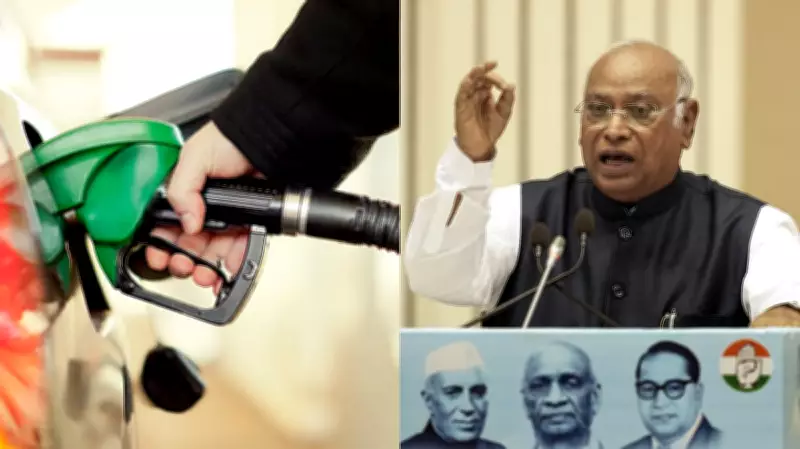
Kharge Accuses Government of Profiteering as Global Oil Prices Drop
Congress President Mallikarjun Kharge on Monday sharply criticized the Narendra Modi-led government over persistently high fuel prices in India, even as global crude oil rates have declined significantly. In a pointed attack, Kharge accused the government of "looting the public" by not passing on the benefits of lower international oil prices to consumers.
Kharge's remarks came during a press conference in New Delhi, where he highlighted the widening gap between global crude prices and domestic petrol and diesel rates. He stated that while crude oil prices have fallen by over 30% from their peaks in 2022, Indian consumers continue to pay elevated prices at the pump.
Data Points and Accusations
Kharge cited official data showing that the average price of Indian crude oil basket dropped from around $120 per barrel in June 2022 to about $80 per barrel in recent weeks. Despite this, petrol and diesel prices in India have remained largely unchanged since May 2022, when the central government cut excise duty by ₹8 per litre on petrol and ₹6 per litre on diesel. State-owned oil marketing companies have not revised retail prices downward.

"The Modi government is looting the public. When global crude prices were high, they increased taxes and passed on the burden to the people. Now that prices have fallen, they are not reducing fuel rates. This is a clear case of profiteering at the expense of common citizens," Kharge said.
Impact on Inflation and Common People
The Congress chief also linked high fuel prices to rising inflation, which has eroded household budgets. He noted that transport costs have surged, pushing up prices of essential commodities. "Every item that reaches your home comes on a vehicle that runs on diesel or petrol. The government's refusal to cut prices is directly fueling inflation," he added.
Kharge demanded that the central government immediately reduce excise duty and ask oil companies to lower retail prices. He also called for bringing petrol and diesel under the Goods and Services Tax (GST) to ensure uniform pricing and lower rates.
Political Context and Government Response
The attack comes amid a broader opposition campaign against the Modi government on economic issues ahead of upcoming state elections. The ruling Bharatiya Janata Party (BJP) has defended its fuel pricing policy, stating that the excise duty cuts in 2022 provided significant relief and that global crude prices remain volatile.
However, Kharge dismissed the government's arguments, saying, "The government is making excuses. They have the power to reduce prices but are choosing not to. This is a deliberate policy to fill their coffers at the cost of the poor and middle class."
Fuel prices in India are determined by a combination of international crude prices, excise duty, dealer commission, and state-level VAT. While the central government reduced excise duty in 2022, several states have not cut their own taxes, leading to wide variations in retail prices across the country.
Consumer Sentiment and Market Outlook
Consumers have expressed frustration over the lack of relief. According to a recent survey by LocalCircles, over 70% of respondents said high fuel prices are affecting their monthly budgets. The issue has become a political flashpoint, with opposition parties planning protests in the coming weeks.
Meanwhile, global crude oil prices have been under pressure due to slowing demand from China and increased supply from non-OPEC producers. Analysts expect prices to remain subdued in the near term, which could increase pressure on the Indian government to act.
Kharge concluded his statement by warning that if the government does not reduce fuel prices, the Congress will launch a nationwide agitation. "The people of this country will not tolerate this loot. We will take to the streets if needed," he said.