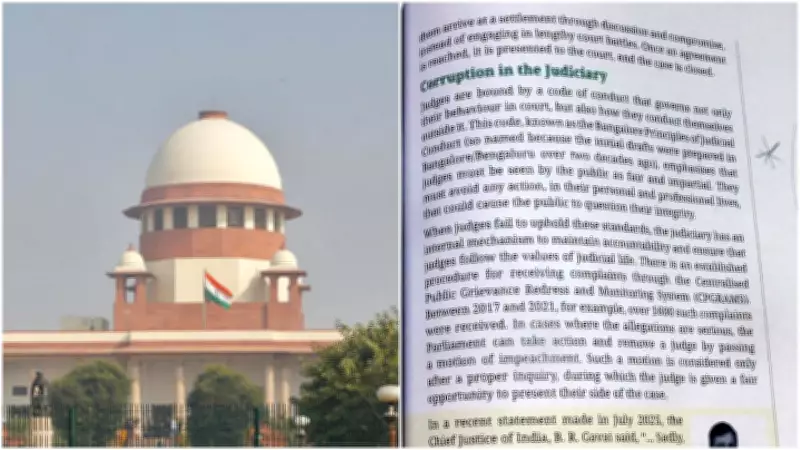
Supreme Court Takes Action Against NCERT Over Controversial Textbook Content
The Supreme Court of India has taken decisive action against the National Council of Educational Research and Training (NCERT), issuing a formal show-cause notice and demanding the immediate removal of a controversial chapter from its textbooks. The chapter in question contains inflammatory language, including the phrase "Judiciary bleeding, they fired gunshots," which has drawn severe criticism from legal experts and the judiciary itself.
Court's Stern Response to Inflammatory Material
During proceedings on February 26, 2026, the Supreme Court bench expressed strong disapproval of the contentious content, describing it as highly inappropriate and damaging to public perception of the judicial system. The court emphasized that educational materials must maintain factual accuracy and respect for constitutional institutions, particularly when discussing sensitive topics related to governance and law.
The show-cause notice requires NCERT to explain why such material was included in official textbooks and what measures will be implemented to prevent similar occurrences in the future. Legal observers note this represents one of the most direct judicial interventions into educational content in recent years.

Unconditional Apology from Solicitor General
In a significant development during the hearing, Solicitor General Tushar Mehta offered an unconditional apology on behalf of NCERT. He acknowledged the gravity of the situation and assured the court that appropriate corrective actions would be taken promptly. The apology underscores the seriousness with which the government views this matter and its commitment to upholding the dignity of judicial institutions.
"The inclusion of such language in educational materials is completely unacceptable," Mehta stated before the bench. "NCERT recognizes its responsibility in this matter and will implement all necessary corrections."
Broader Implications for Educational Content Standards
This incident has sparked broader discussions about content review processes within educational publishing bodies. Experts are calling for:
- Enhanced scrutiny mechanisms for textbook content before publication
- Greater involvement of subject matter experts in content development
- Clearer guidelines regarding discussion of constitutional institutions
- Regular audits of existing educational materials for problematic content
The Supreme Court's intervention highlights the critical role educational materials play in shaping young minds and their understanding of democratic institutions. As the case progresses, it is expected to establish important precedents regarding accountability in educational publishing and protection of institutional integrity.