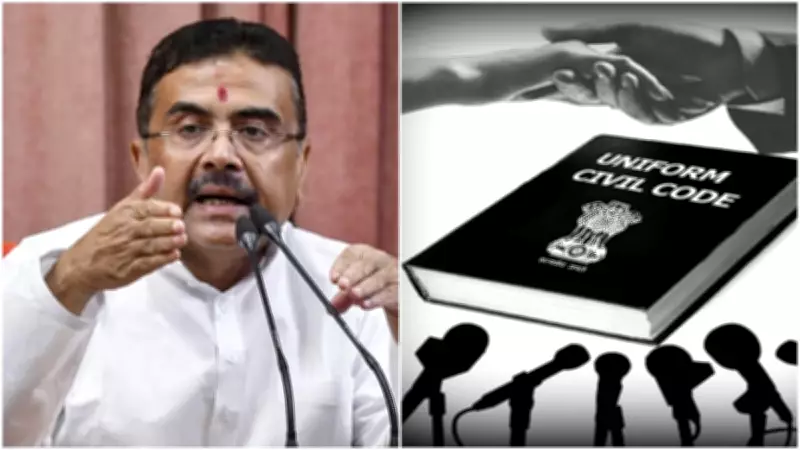
The West Bengal government is set to table the Uniform Civil Code (UCC) Bill in the state assembly, fulfilling one of the BJP's most ambitious and politically sensitive promises. The move has sparked sharp criticism from the opposition, with the BJP accusing the Trinamool Congress (TMC) and Congress of sacrificing women's rights.
BJP's Accusations Against TMC and Congress
BJP leaders have slammed the TMC and Congress, alleging that they have historically opposed the UCC, thereby neglecting women's welfare. According to BJP state president Sukanta Majumdar, the UCC will ensure equal rights for all citizens, particularly women, by replacing personal laws based on religious customs.
The BJP claims that the TMC and Congress have consistently blocked the UCC to appease minority vote banks, undermining gender justice. Majumdar stated, "The TMC and Congress have sacrificed women's rights at the altar of vote bank politics. The UCC will correct this historical wrong."

Details of the UCC Bill
The Bill is expected to be introduced during the upcoming session of the West Bengal Assembly. It aims to establish a common set of laws governing marriage, divorce, inheritance, and adoption for all citizens, irrespective of religion. This would replace the existing personal laws applicable to different religious communities.
The government has not yet released the full text of the Bill, but it is anticipated to include provisions for gender equality and uniform legal procedures. The UCC has been a long-standing promise of the BJP, both at the national and state levels.
Political Reactions and Implications
The TMC has vehemently opposed the Bill, calling it an attack on religious freedom. TMC spokesperson Kunal Ghosh said, "The UCC is a divisive agenda aimed at destroying the secular fabric of our nation. We will fight it tooth and nail." Congress leaders have also criticized the move, accusing the BJP of imposing a majoritarian agenda.
Political analysts suggest that the Bill could polarize the electorate in West Bengal, which is due for assembly elections in 2026. The BJP hopes to gain support from Hindu voters, while the TMC is banking on minority consolidation. The Bill's passage is uncertain, as the TMC has a majority in the assembly, but the BJP is pushing for a debate.
Historical Context of UCC in India
The Uniform Civil Code is enshrined in Article 44 of the Indian Constitution as a Directive Principle of State Policy. It has been a contentious issue since independence, with successive governments failing to implement it due to political opposition. The BJP has made the UCC a key part of its manifesto, arguing that it is essential for national integration and gender justice.
Several states, including Uttarakhand and Gujarat, have already taken steps towards implementing the UCC. West Bengal's move is seen as a significant development, given the state's diverse religious demographics and political landscape.