

The Ministry of External Affairs recently clarified that a passport is primarily a travel document and not a conclusive proof of citizenship. This suo motu statement reopened an old but important debate: does India need a single, definitive proof of citizenship? The public reaction was one of surprise. If a passport is not conclusive proof, then what is? Is Aadhaar proof of citizenship? Is a voter identity card? Is there any document that finally settles the question? The answer is a straightforward no. India has never had a single, universal citizenship document.
Confusion Between Identity, Residence, and Citizenship
The confusion arises because we often conflate three distinct concepts — identity, residence and citizenship. They are related, but not the same. Aadhaar establishes identity and residence. A passport facilitates international travel. A voter identity card establishes eligibility to vote. None of them, by itself, is a statutory and conclusive proof of citizenship for all purposes, though the last two are issued only to citizens.
Citizenship in India is governed by the Citizenship Act, 1955, and may be acquired by birth, descent, registration or naturalisation. In practice, it is established through a combination of records rather than one definitive certificate.

Global Practices and India’s Missed Opportunity
Many countries maintain citizen registers or issue citizenship-linked identity cards. Pakistan, Bangladesh, Nepal, Bhutan, Sri Lanka, the Maldives and most European countries have cards that function as primary proof of citizenship. At the other end are countries like the US, the UK and Canada, which rely on birth records, passports and other official documents. India is more like the latter: We have multiple identity systems but no single, universally accepted proof of citizenship.
The Aadhaar experience is instructive. Conceived in 2009, it was designed as a unique identity instrument for residents to improve welfare delivery and eliminate duplication. It was deliberately kept separate from citizenship. I don't know why. Enrolment was based on residence, not nationality. Consequently, Aadhaar has never been proof of citizenship. It was a missed opportunity. We should have designed it as a dual-purpose document.
The Assam NRC: A Cautionary Tale
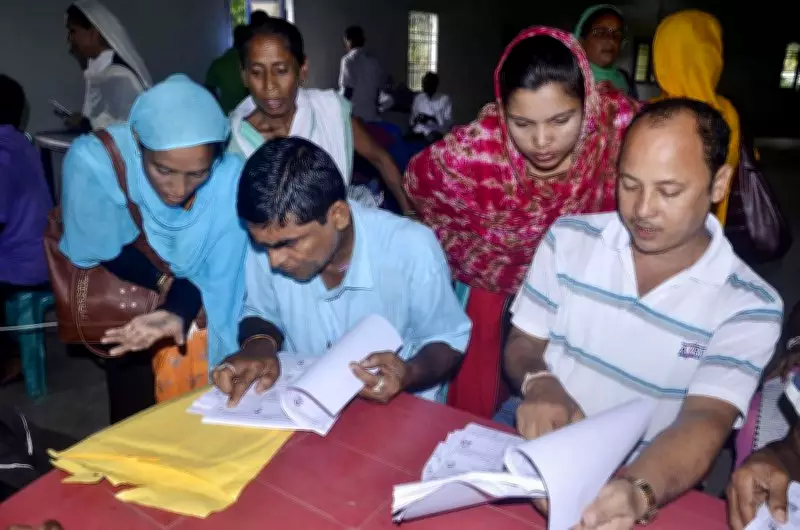
The citizenship debate resurfaced most dramatically in Assam. The Assam National Register of Citizens (NRC) was not an identity exercise; it was a citizenship verification exercise rooted in the state's history of illegal migration. Under the Assam Accord of 1985, residents had to prove that they or their ancestors were present in India before March 24, 1971.
Conducted under Supreme Court supervision, the exercise involved thousands of officials, cost over Rs 1,500 crore and continued for nearly five years. Yet the outcome proved deeply contentious. About 19 lakh applicants were excluded from the final list published in 2019. Many who had long demanded the NRC believed illegal migrants had still been included, while many excluded persons claimed that genuine citizens had been left out. The final list has yet not been notified and remains in limbo.
Why did an exercise supervised by the SC fail? The answer lies in the complexity of proving citizenship retrospectively. Millions of ordinary Indians — the poor, migrants, women, landless labourers and people displaced by floods or erosion — struggled to produce documentary evidence stretching back decades. Spelling variations, missing records and name changes after marriage created complications. When over three crore people are asked to establish citizenship through historical records, errors are inevitable.
Forgery Arguments and Public Trust
The argument that passports or voter cards can be forged is spurious. It applies equally to any document submitted to the NRC. Forgery is an argument for stronger verification systems, not for dismissing any particular document.
The Assam experience raises a larger question: if such difficulties arose in one state with a population of 3.3 crore, can a nationwide exercise involving 145 crore people be undertaken without causing widespread hardship? The question is not merely administrative; it is also about public trust.

Having spent six years in the Election Commission, I know that citizens react sharply to any process perceived as burdensome or exclusionary. The controversy surrounding the recent Special Intensive Revision (SIR) of electoral rolls illustrates this. People do not object to verification per se. They object when they are repeatedly asked to produce old documents and run from office to office. Any citizenship exercise will face resistance if citizens believe it is being implemented selectively or punitively.
A Citizen-Friendly Roadmap
Public convenience, not harassment, must be the governing principle. Does this mean India should abandon the idea of a definitive proof of citizenship? No. Parliament has already pointed the way. The Citizenship Act, as amended in 2003, envisaged compulsory registration of every citizen, maintenance of a National Register of Indian Citizens and issuance of national identity cards. The accompanying rules provided for a National Population Register followed by verification and preparation of the NRC. The legal architecture has thus existed for over two decades. What has been missing is a citizen-friendly roadmap and the political will to implement it even handedly — and without haste.
That roadmap should rest on two foundations. First, universal birth registration, made compulsory by an Act in 1969, must become the bedrock of future citizenship records. I suggest a twin approach:
- Those having the birth certificate (nearly 80 crore — 65-70% — have it) can be given a citizenship card straightaway.
- For older generations, the state should rely primarily on existing official records — electoral rolls, passports, government service records, tax filings, pension records and educational certificates. These documents represent decades of the state's own recognition of its citizens.
The effort should be inclusion, not suspicion. The burden should not fall on ordinary citizens to prove their citizenship; it should rest on the State to establish, on credible grounds, that a person's status is genuinely in doubt. Even if it takes 5-10 years. After all, the Republic has survived without the citizenship certificate for seven decades.
Balancing Security and Trust
Illegal immigration is a challenge and demands a serious response. But the tools to address it must be targeted and evidence-based, not rash ones that sweep millions of genuine citizens into a bureaucratic net designed to catch a few.
Citizenship is the foundational relationship between the individual and the State. The state must certainly know who its citizens are. But it must do so in a manner that reassures rather than intimidates, includes rather than excludes, and strengthens rather than weakens the bond of trust between a citizen and the State.





