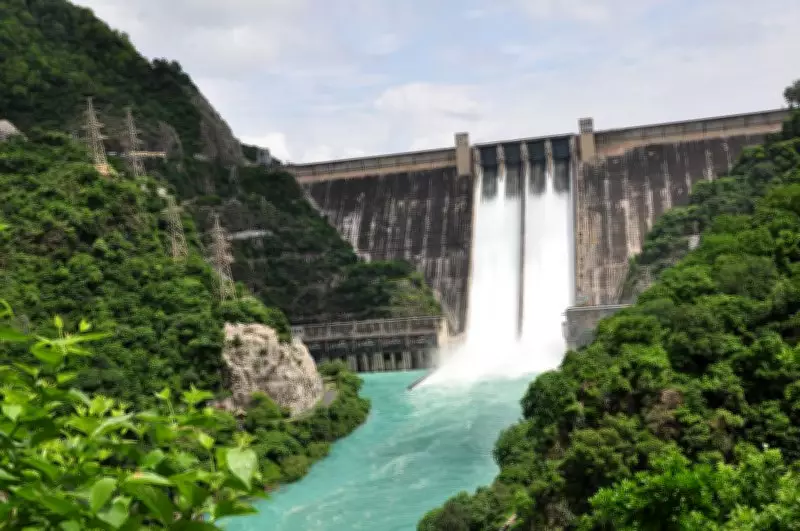
The Bhakra Beas Management Board (BBMB) has moved to allay concerns regarding the safety of the Bhakra Dam, asserting that recent reports linking increased dam deflection to structural risks and silt buildup are misleading.
Officials Reassure on Dam Integrity
Senior BBMB officials maintain that the dam remains secure and that the observed deflection is a standard engineering phenomenon primarily associated with reservoir water levels. Speaking to The Tribune, Bhakra Dam Chief Engineer CP Singh provided detailed clarification.
Deflection Within Safe Limits
Singh stated that the maximum recorded deflection of the dam reached 1.1770 inches in November 2025. While this exceeded the original design deflection limit of 1.03 inches under normal loading conditions, it remained well within the permissible seismic design limit of 1.53 inches. He noted that the designed threshold of 1.03 inches was first crossed in 1995 and has been exceeded 15 times over the past three decades.

“The loading of the dam structure increases during the filling period when reservoir levels rise and decreases during the depletion period when water levels recede,” Singh explained. He added that the current deflection has reduced significantly to about 0.699 inches.
Reservoir Operations Influence Deflection
The chief engineer highlighted that the reservoir operations pattern over the last five years has contributed to relatively higher baseline deflection levels. The reservoir has not been depleted below around 1,550 feet in recent years, compared to the minimum level of 1,462 feet. Consequently, the dam structure has not fully returned to its original position during the depletion cycle.
“When the minimum deflection remains higher, the maximum deflection recorded during the subsequent filling season also tends to remain elevated,” Singh said.
Factors Beyond Water Loading
BBMB officials clarified that several factors influence dam deflection aside from water loading, including temperature variations, rainfall in the dam region, and spillway operation. Singh noted that the dam recorded comparatively higher deflection last year because reservoir levels were maintained at high levels for nearly a month.
Silt Accumulation Not a Threat
Addressing speculation about silt accumulation in the reservoir, the Chief Engineer rejected claims that sedimentation was exerting pressure on the dam structure. Studies indicate that while siltation has reduced the overall storage capacity of the Gobind Sagar reservoir by about 26% and active storage by around 19%, it has no direct impact on the deflection of the concrete dam.
“The silt deposits are located nearly 10 kilometres away from the dam structure and do not exert any significant pressure on the dam. Deflection is linked primarily to water loading and operational factors, not sediment accumulation,” he said.
Expert Inspection and Future Studies
CP Singh further revealed that an independent panel of experts inspected the Bhakra Dam in February 2026 and declared the structure safe. The board has also signed a Memorandum of Understanding (MoU) with IIT Roorkee and international experts to conduct a detailed scientific study of the dam’s deflection behaviour and recommend measures, if necessary.
The BBMB emphasized that the dam’s behaviour continues to be monitored through an extensive instrumentation and surveillance system, and all observed parameters remain within safe limits.