

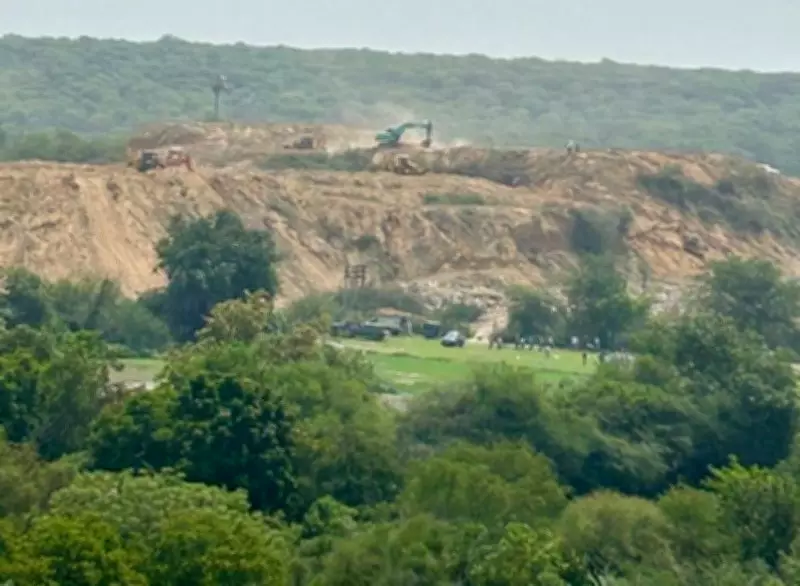
Prominent scientists, environmental policy experts, and conservation organizations from across India have written to Chief Justice of India Surya Kant, seeking changes to the newly constituted Supreme Court committee tasked with examining the protection of the Aravalli range. They argue that the panel lacks the independence and expertise required for such a critical task.
Concerns Raised Over Committee Composition
In representations submitted on June 18 and 19, the experts raised concerns over the composition of the committee formed under the Supreme Court's May 25, 2026, order. They contend that it does not meet the standards of an independent High Powered Expert Committee envisaged by the court in its December 29, 2025, suo motu proceedings.
Stalin Dayanand, Director of Vanashakti, said the committee could not be considered impartial as its Chairperson and Member Secretary are linked to institutions under the Ministry of Environment, Forest and Climate Change (MoEFCC), whose earlier recommendations are now under review. “The new committee does not fulfil the criteria of being a High Powered Expert Committee nor being impartial or independent,” he said.

Allegations of Ignored Findings
Joseph Hoover, Managing Trustee of the United Conservation Movement, alleged that the MoEFCC had ignored findings of a September 2025 Forest Survey of India (FSI) report that highlighted the importance of low-lying hills as barriers against desertification. He also questioned discrepancies between the FSI report, which identified 63 Aravalli districts, and the ministry's affidavit before the Supreme Court, which referred to only 37 districts.
Veteran environmentalist Dr Ravi Chopra, who has previously chaired Supreme Court-appointed committees on environmental matters, expressed doubts about the panel's ability to provide unbiased recommendations. “Government officials and scientists from government-funded institutions rarely record views contrary to those of the government despite expressing concerns during discussions,” he wrote to the Chief Justice.
Calls for Independent Experts
Geoscientist Prof C P Rajendran said the committee should include independent environmentalists, ecologists, hydrologists, scientists, and public health experts rather than being dominated by serving or retired officials. Environment and policy expert Sagar Dhara noted that the Supreme Court had previously appointed eminent independent experts such as Dr Ravi Chopra and physicist Prof M G K Menon to head high-powered committees dealing with environmentally sensitive issues.
Pushkar Kulkarni of Save Pune Hills said any assessment of mining in the Aravallis would be incomplete without examining its impact on health and livelihoods. Odisha-based environmentalist Prafulla Samantara demanded that neither the Chairperson nor the Member Secretary be serving officers of the MoEFCC or its affiliated institutions.
Demands for Transparency and Extended Timeline
Environmentalist Samita Kaur called for the inclusion of experts in ecology, wildlife, hydrology, occupational health, and traditional livelihoods, while Dr Sumita Kale of Pune urged that the committee submit its report directly to the Supreme Court and be granted additional time beyond the current August 31 deadline to conduct consultations across all Aravalli districts.
The Aravalli range is considered crucial for biodiversity conservation, groundwater recharge, and preventing the eastward spread of the Thar desert, making its protection a matter of national environmental significance.






