Gurgaon: Residents of Tulip Ivory in Sector 69 woke up to a power outage around 6:30 am on Thursday. Hours passed without restoration. By afternoon, lifts, water supply systems, security infrastructure, and common area services were running entirely on diesel generators. As the outage stretched beyond eight hours, the RWA's concern shifted from the power cut itself to the fuel being consumed to keep the society functioning.
Massive Diesel Consumption
"Around 200 litres of diesel was consumed within two hours, and even whatever we had in store is nearly over. When we asked for diesel, the vendor told us about the capping," said Ajay Pal Singh, RWA president of Tulip Ivory. Power was restored more than 12 hours later, around 7:15 pm, after 1,400 litres of diesel had been used.
Condominiums are bulk consumers of diesel because power outages are frequent across the NCR, especially in summer, when old feeders cannot match rising loads and lines within societies become prone to faults. Residents said Thursday's outage was triggered when a damaged jumper led to the burnout of a vacuum circuit breaker.

Dependence on Generators
For thousands of residents, electricity is about far more than lighting and air conditioning. High-rise societies depend on continuous power for sewage treatment plants, security networks, fire-safety equipment, and access-control systems. When grid power fails, diesel generators effectively become the backbone of the society.
"We have already requested residents to use electricity judiciously. However, there is a limit to how much demand can be curtailed. Lifts, security systems, and common-area services cannot simply be switched off. The real challenge arises when power cuts are prolonged," Singh said.
Govt Diesel Capping Order
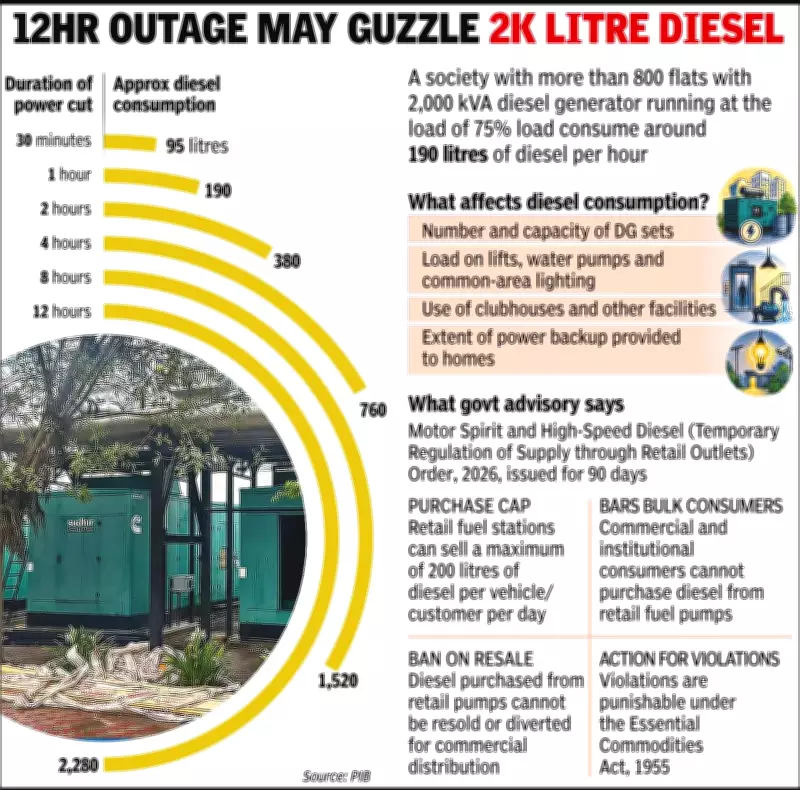
The timing could hardly have been worse. On June 12, the Centre issued the Motor Spirit and High-Speed Diesel (Temporary Regulation of Supply through Retail Outlets) Order, 2026, capping retail diesel sales at 200 litres per vehicle or customer per day and barring bulk consumers from buying fuel at retail pumps. The 90-day order was prompted by escalating supply concerns linked to the US-Israel conflict with Iran, and was meant to prevent hoarding and protect fuel availability. For housing societies that lean on diesel generators during outages, however, it has triggered fresh anxiety, with some estate offices and management teams already issuing advisories warning residents of the potential fallout.
Logistical Challenges
Most societies buy diesel from retail pumps. Bulk-purchase outlets exist separately but charge about Rs 30 more per litre, and the nearest one serving Gurgaon is in Delhi or Rohtak, adding further logistical cost.
RWAs argue the govt's order overlooks operational realities. "Even when running without load, a generator can consume 30-40 litres of diesel per hour, and consumption rises to 50-70 litres under load. In our society, a one-hour power outage typically results in diesel consumption of around 190 litres. Most suppliers also do not deliver small quantities; a tanker usually carries about 1,000 litres or more. So far this month, we have procured nearly 6,000 litres of diesel and already consumed over 3,500 litres," said Praveen Malik, president of Rising Homes RWA.
Scale of Consumption
The scale of consumption in larger societies illustrates the stakes. In a high-rise complex with more than 1,000 flats, a 30-minute outage can mean burning through 150-200 litres of diesel to run a genset; an hour-long cut can push consumption to 300-400 litres; and a two-hour outage can drive it as high as 800 litres.
"The district administration should intervene so that housing societies do not face problems while procuring the basic essential commodities," said Jaswant Rao, president of the society's RWA.