

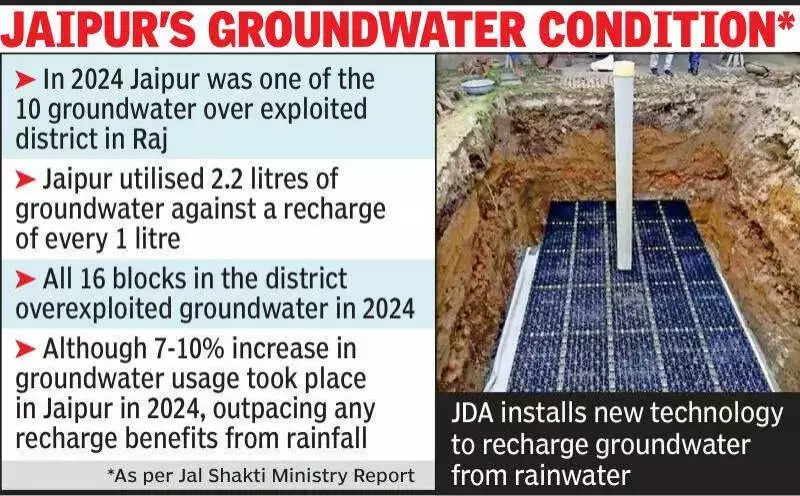
In a pioneering move for sustainable urban water management, the Jaipur Development Authority (JDA) is set to implement a novel water harvesting technology for the first time in the Pink City. The initiative aims to recharge the depleting groundwater table using accumulated rainwater in specific areas.
Jaipur's First Eco Block Implementation
The civic body will deploy Eco Block technology as a core component of a new drainage project planned for residents of Kalwar Road and Khirni Phatak areas. While this technology has been previously used by the National Highways Authority of India on highways near Delhi and Agra, and even within the Rashtrapati Bhavan complex in New Delhi, this marks its maiden application by the JDA.
Amrit Singh, Executive Engineer of JDA, explained the project's goal. He stated that while the technology won't capture the entire volume of rainwater, it will ensure a significant portion is recharged into the aquifer. The surplus water will be efficiently drained into the Dravyavati River. "If the method acts successfully, we may implement this technology in other areas of the city," Singh added, highlighting the pilot nature of this project.

Project Cost and Technical Details
The JDA has allocated a substantial budget for this comprehensive infrastructure upgrade. The total cost for laying the 8.75 km-long drainage line is Rs 25.50 crore, out of which approximately Rs 2 crore is dedicated specifically to the groundwater recharge technology. For execution, the JDA has partnered with a Chennai-based firm specializing in this domain.
Engineers champion the technology for being cost-effective and space-efficient. The system involves installing specialized paver block-like structures that are concealed within geo-textile membranes. These membranes act as filters, blocking solid particles like plastics and allowing only clean water to seep through into the blocks. The blocks then facilitate the percolation of water down to recharge the groundwater, while any excess is diverted into the main drainage lines.
Deployment Strategy and Timeline
Detailing the implementation plan, Singh mentioned that the structures will be placed in the interstitial spaces between buildings and road edges. A technical team from the Chennai firm will visit Jaipur to conduct necessary soil testing and finalize the exact locations for installation.
"These blocks would occupy an area of only one square metre with a depth of three metres," Singh noted, emphasizing the minimal footprint. He confirmed that all required clearances for the drainage project have been secured, and groundwork is expected to commence soon. This project represents a critical step for Jaipur in building resilience against water scarcity through innovative and practical engineering solutions.

