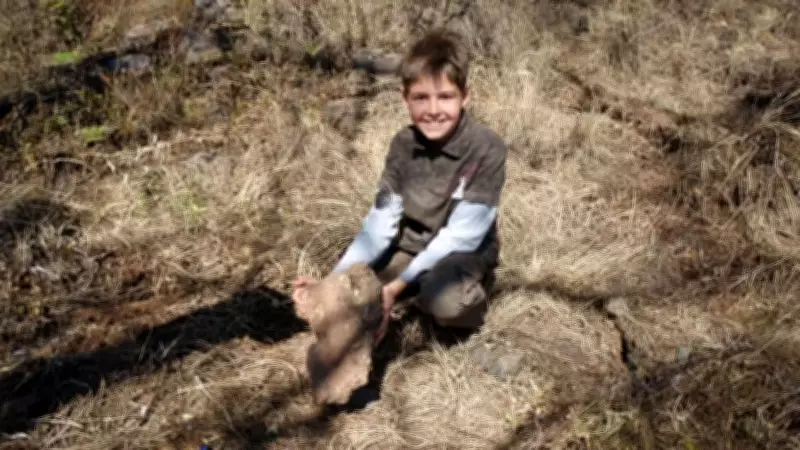
It was an ordinary afternoon for Matthew Berger, known as Matt Berger, when he accompanied his father, Lee Berger, a renowned paleoanthropologist. The 9-year-old boy was chasing his dog when he stumbled upon a rock with a bone protruding from it. Unbeknownst to him, this moment would answer one of humanity's greatest questions. He had tripped on the fossil of a previously unknown human ancestor. What began as a child's curiosity soon led to one of the most significant paleoanthropological discoveries of the decade.
A Field Trip That Changed Humankind's Evolutionary History
The year was 2008. Matt was 9 years old and often joined his father on field trips. Lee Berger, a prominent paleoanthropologist studying fossils of human ancestors, had faced struggles in the early 2000s. On 15 August 2008, Matt traveled with his dad to South Africa. Lee was exploring the Malapa Cave area near Johannesburg, part of a World Heritage Site known as the 'Cradle of Humankind,' which contains key evidence of human evolution.
Lee planned to explore a location he had marked on Google Earth. "We got to the edge of this hole. Really just a hole in the ground, five metres by five metres, not a huge cave that most people would imagine. And my dad said, 'OK Matt, go find fossils,'" Matt told the BBC fifteen years after the discovery.

Matt's dog began exploring, and Matt followed. "My dog started running away from the site. I started following him, and I tripped on a log, and as I was getting myself up and dusting myself off, I noticed a little fossil in a rock on the side of this path," he recalled.
The Moment of Awe
Matt informed his father, who immediately recognized the fossil as a collarbone of a hominid, a group of great apes that includes humans and their close ancestors. "We were all kneeling around this rock, just in awe. I didn't really know what was happening because I'd never found a hominid. I was just there for fun. But my dad was so excited, and so obviously that made me excited," Matt said.
Soon, they found more remains in the rock. "As we're admiring this rock and looking at it, we turn it over, and on the backside is a jaw with teeth of a hominid sticking out. And so that's when we knew this was going to be a significant find, because finding a single piece is already a huge deal – finding two in the same block, knowing that they could be from the same individual, which would lead to a partial skeleton, was almost unheard of."
What Matt accidentally discovered was a previously unknown ape-like species, Australopithecus sediba. This species lived almost 2 million years ago. Two weeks later, Lee and his colleagues excavated the site, learning more about the find. Some scientists believe this species could be a direct ancestor of modern humans.
A child's curiosity turned out to be one of the biggest discoveries in the history of human evolution.