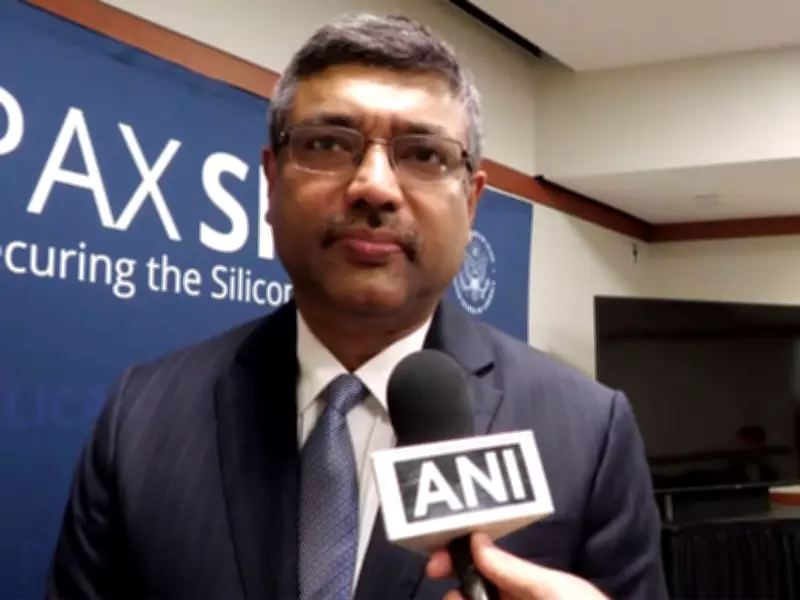
India has formally sought assurance from the United States that access to advanced artificial intelligence technologies, such as Anthropic's Claude models, will not face abrupt cutoffs, according to S Krishnan, Secretary of the Ministry of Electronics and Information Technology (MeitY). Speaking on the sidelines of the 2nd Pax Silica Summit in Washington, Krishnan highlighted the need for a predictable and secure technology-sharing framework as India integrates these tools into its digital infrastructure and public services.
Key Demand: Reliable Access Without Sudden Disruption
Krishnan stated that India requested a clear understanding of how the US views the issue and what measures would ensure that for trusted partners, access to frontier AI remains uninterrupted. “We sought an understanding of how exactly the US is looking at this particular aspect and what their concerns are and how, in the future, this could be a reliable source of technology, because if it is something which is to be used and made available, we can't have abrupt cutoffs,” he said. The US provided assurances that for trusted partners, access will not be an issue going forward.
Risks of Abrupt Cutoffs to AI Technology
An abrupt cutoff could mean sudden revocation or restriction of access to foundational AI models, which could arise from shifting geopolitical policies, evolving export control regulations, or unilateral commercial decisions. For India, integrating these models into sensitive sectors like governance, healthcare, and education, a sudden loss of access would halt long-term AI-driven initiatives and compromise developmental goals. In June, the US Commerce Department issued an export control directive ordering Anthropic to restrict foreign nationals from using its newly launched Claude Fable 5 and Mythos 5 models, underscoring the vulnerability.

Discussions on AI Collaboration and Supply Chains
Krishnan noted that the discussions covered deepening India-US technology collaboration, the evolution of AI innovation, and deployment across manufacturing, agriculture, healthcare, education, and governance. Both sides recognized that no single country can independently build the entire AI ecosystem, and global collaboration is essential. “There was a recognition that India needs to play a much bigger role in the global supply chain and how it has been developing and growing,” he added.
Building Resilient and Diversified AI Supply Chains
At the Pax Silica Summit, countries explored ways to build diversified and resilient supply chains across the entire AI stack, including energy availability, data center infrastructure, semiconductor supply chains, AI model development, data usage, and mechanisms to ensure AI benefits society. “The important element is the way that different countries in the world will come together to build a diversified and resilient supply chain for all that is needed in the AI stack,” Krishnan said.
The Indian delegation sought direct clarity on the US regulatory framework and long-term approach to AI, aiming to transition from ad-hoc usage to a secure, predictable framework. According to Krishnan, the discussions yielded positive results, with the US providing assurances on future partnership stability.