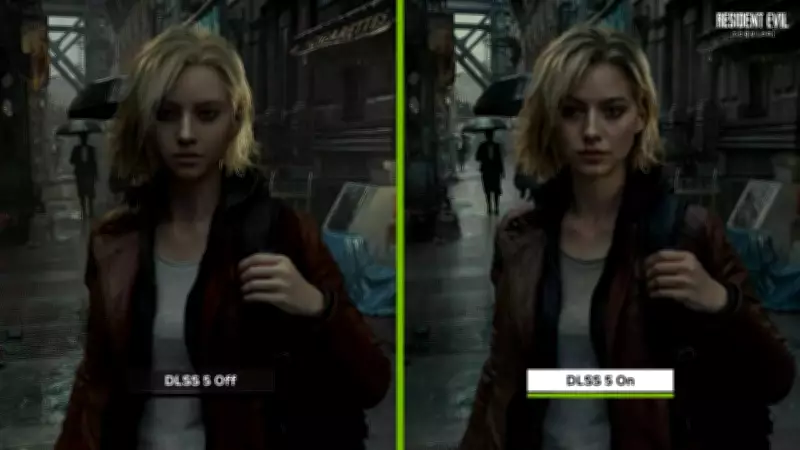
Nvidia Unveils DLSS 5: A Revolutionary Leap in Real-Time Computer Graphics
Nvidia has officially announced DLSS 5, marking its most ambitious advancement in computer graphics technology since the introduction of real-time ray tracing back in 2018. Revealed at this week's GTC event, DLSS 5 represents a groundbreaking real-time neural rendering model designed to inject photorealistic lighting and materials directly into game frames. This level of visual fidelity was previously exclusive to Hollywood VFX pipelines, which often require minutes or even hours to render a single frame.
Jensen Huang's "GPT Moment for Graphics"
Nvidia CEO Jensen Huang has hailed DLSS 5 as "the GPT moment for graphics," describing it as a sophisticated blend of hand-crafted rendering techniques and cutting-edge generative artificial intelligence. The technology operates by taking a game's existing colour data and motion vectors as input, then utilizing a trained AI model to reconstruct the entire scene with enhanced photorealistic lighting and materials. Crucially, this process remains firmly anchored to the original 3D content, ensuring frame-to-frame consistency while operating in real time at resolutions up to 4K.
How DLSS 5 Transforms Single Frames into Photorealism
The DLSS 5 model is trained end-to-end to comprehend complex scene semantics, including intricate details like characters, hair, fabric, and translucent skin, alongside diverse environmental lighting conditions—all derived from analyzing just a single frame. The resulting visual enhancements are nothing short of striking, featuring advanced subsurface scattering on skin, the delicate sheen of various fabrics, and precise light-material interactions on hair. These effects are achieved with a level of accuracy that traditional real-time rendering methods have consistently struggled to match.

It is important to note that DLSS 5 does not replace path tracing; rather, it complements it. Path tracing continues to handle the fundamental accuracy of lighting—determining where shadows and reflections should fall—while DLSS 5 builds upon this foundation to deliver superior lighting photorealism. The effect is akin to providing the renderer with a significantly larger ray budget and access to higher-quality materials, all processed in real time.
Major Games and Publishers Embracing DLSS 5
An impressive roster of major publishers has already committed to integrating DLSS 5 support into their upcoming and existing titles. Key industry players such as Bethesda, CAPCOM, Ubisoft, and Warner Bros. Games are on board, with confirmed support for high-profile games including Assassin's Creed Shadows, Starfield, Resident Evil Requiem, Hogwarts Legacy, and The Elder Scrolls IV: Oblivion Remastered. During the GTC demonstration, the technology was showcased running on two RTX 5090 GPUs—one dedicated to rendering and the other exclusively handling the DLSS 5 model. However, Nvidia has assured that optimizations are underway to enable seamless operation on a single GPU prior to the official launch this fall.
Availability and Future Implications
DLSS 5 is scheduled for release in the upcoming fall season, poised to redefine the visual standards of real-time gaming. This innovation not only enhances graphical fidelity but also sets a new benchmark for how artificial intelligence can be leveraged to bridge the gap between pre-rendered cinematic quality and interactive gameplay. As the gaming industry continues to evolve, DLSS 5 stands as a testament to Nvidia's ongoing commitment to pushing the boundaries of what is possible in computer graphics technology.