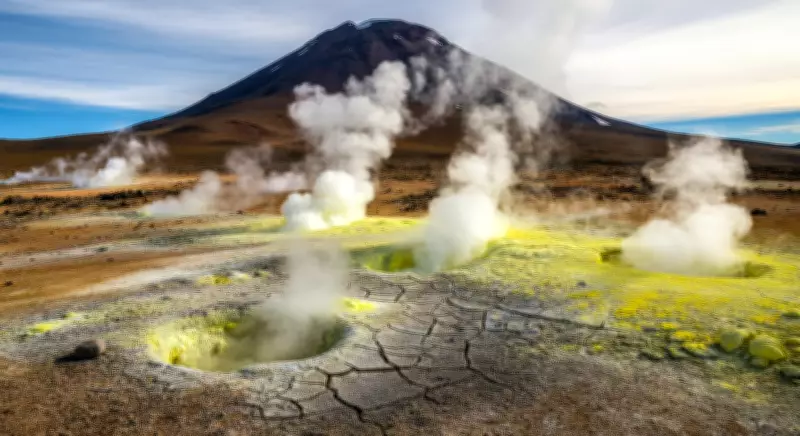
For many years, a huge shadow has loomed over the Bolivian Plateau. Mount Uturuncu, standing more than 6,000 meters above sea level, has intrigued and slightly terrified scientists worldwide. The volcano has not fully erupted in about 250,000 years. Despite being technically inactive, Uturuncu has recently behaved like a giant sleeping fitfully. Satellites and ground sensors have detected continuous earthquakes, constant gas emissions, and a strange deformation of the ground around the peak. This odd geometric deformation, known as sombrero topography, causes the main peak to swell while adjacent slopes subside. For a long time, this signal seemed clear and reassuring.
Moving Beyond the Eruption Countdown
What once seemed like an ominous sign earned Uturuncu the nickname of a zombie volcano. It appeared that an eruption could be imminent, as new batches of hot magma rose from the depths. However, natural processes are rarely that simple.
A breakthrough study published in the journal PNAS completely reshapes our understanding of what is happening inside the restless mountain. The research reveals that the internal mechanics of the volcano are far more complex than a straightforward countdown to an explosion. By utilizing high-resolution seismic imaging and cutting-edge rock-physics modeling, scientists peered directly through the stone heart of the mountain. They discovered that the surface bulging is not caused by a massive, immediate buildup of explosive magma. Instead, the unrest is better explained by a dynamic, churning network of hydrothermal fluids and high-pressure gases migrating through the upper crust of the Earth. While still active and hot, this discovery reduces immediate eruption concerns, suggesting the volcano is expelling steam rather than preparing to explode.

Although a vast amount of heated magma underground serves as the energy source for this process, it is the hot gases causing all the commotion at the surface. This volcano cannot be compared to an overinflated balloon anymore, but instead should be likened to a highly complicated system of steam pipes.
The Perceived Danger from the Dormant Volcano
Such a great change in thinking affects people's perception of the danger posed by the Bolivian volcano. These new results do not suggest that the volcano is now inactive. Instead, the internal processes remain extremely active, hot, and dangerous. However, the new data significantly lowers the immediate fear factor that has surrounded the site for years. An analysis shared by the University of Oxford notes that understanding these shallow fluid pathways helps lower the expectation of a sudden, magmatic blast. The ground is moving because hot gases are searching for an exit, not because an unstoppable wall of lava is on the verge of breaking through the crater.
This revised view demonstrates a new pattern developing within modern geology. With increasing developments in imaging technologies, we now know that volcano activity does not necessarily spell trouble. In many cases, the volcano is simply expelling steam from an old heat source deep beneath the Earth's surface through a network of underground pathways.
Although scientists will certainly keep an eye on the relationship between the shallow steam vents and the magma chambers beneath, the environment can relax a little for the time being. This zombie volcano is not quieting down any time soon, but it seems more intent on cleaning out its pipes than blowing its top.