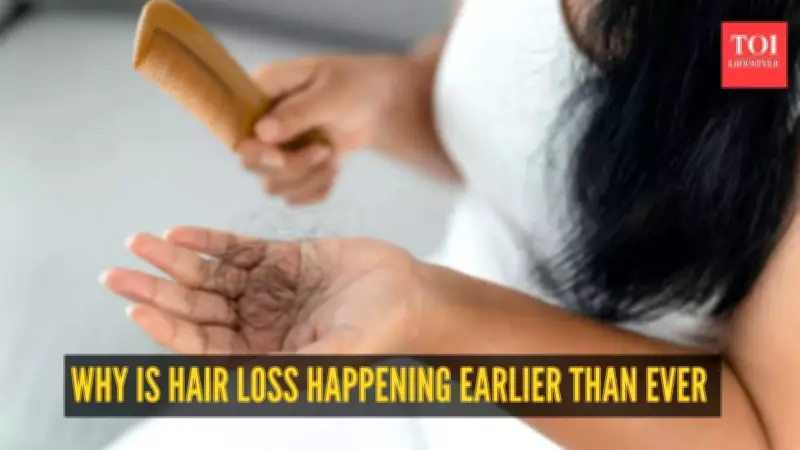
Hair loss used to feel like something people worried about later in life, perhaps in their forties or fifties. Today, however, individuals in their twenties are already noticing thinning hairlines, wider partings, and more strands falling out in the shower than usual. This early onset can be alarming for many young adults.
Early Signs of Hair Loss in Young Adults
For many, the first signs appear quietly: a little extra hair on the pillow, a scalp that becomes more visible in photos, or a ponytail that feels thinner than a year ago. Most people initially brush it off as stress or weather changes until they realize their hair density has genuinely changed. The truth is, something has shifted.
Genetics still play a major role, but modern lifestyles are causing hair fall to show up much earlier and more aggressively. Constant stress, poor sleep, crash diets, hormonal imbalances, long working hours, and nutritional deficiencies are all putting extra pressure on hair health. In fact, the conversation around hair loss has become so serious globally that South Korea's President Lee Jae Myung, who took office in 2025, pushed for national health insurance coverage for hair loss treatments. This highlights how widespread the issue has become, affecting confidence, mental health, and emotional wellbeing.

Why Hair Loss Is Starting Younger Now
One of the biggest reasons behind early hair loss is Androgenetic Alopecia, or pattern hair loss, driven by sensitivity to DHT (dihydrotestosterone), a hormone that slowly shrinks hair follicles. In men, this often shows as a receding hairline or thinning near the crown; in women, it appears as a widening parting or overall thinning near the top of the scalp. However, genetics rarely work alone anymore.
Stress has become one of the biggest triggers. Chronic stress can push hair follicles into a resting phase prematurely, causing Telogen Effluvium, where hair fall often starts two or three months after the stressful event, making the connection easy to miss. Modern life—poor sleep, endless screen time, work pressure, emotional burnout, overthinking, and irregular eating habits—quietly affects hormone balance and scalp health over time. For women, hormonal conditions like PCOS and thyroid disorders are common causes of hair thinning that often go undiagnosed for years.
Nutrition matters more than most realize. Low iron stores (especially ferritin), Vitamin D deficiency, low protein intake, and crash dieting can weaken hair growth significantly, a trend dermatologists see increasingly in young urban Indians with busy schedules and irregular eating habits. The good news is that many of these triggers are treatable once identified early.
Hair Loss Treatments Have Evolved
Hair restoration treatments today are far more advanced than a few years ago. Options once felt limited, but now doctors have a wider toolkit depending on the cause and severity of hair loss. Minoxidil, both topical and oral, remains common, improving blood flow to hair follicles and slowing thinning while encouraging regrowth. For hormone-related hair loss, DHT blockers may be recommended under medical supervision.
Regenerative treatments have changed dramatically. GFC therapy is replacing traditional PRP. While many have heard of PRP (Platelet-Rich Plasma), where a person's blood is processed and injected into the scalp, many clinics now shift to GFC (Growth Factor Concentrate). It still uses the patient's blood but extracts a more concentrated mix of growth factors for stronger follicle stimulation. Patients often see improvements in hair density, reduced shedding, and thicker strands over time.
Regenera Activa offers a different approach. This involves taking a tiny scalp tissue sample (just 2.5 mm) and processing it to extract regenerative cells and growth factors, which are then injected into thinning areas. Many patients like it as a single-session treatment, with results noticeable within a few weeks.

Exosome therapy is one of the most talked-about advancements. Exosomes are tiny biological messengers that send signals to dormant or weakened follicles, encouraging them to become active while reducing inflammation and improving scalp circulation. There are human-derived exosomes (from placenta, fat tissue, or bone marrow) with stronger scientific backing, and plant-derived versions (from ginger or rose) as emerging alternatives. Quality matters hugely, so this treatment should only be pursued through qualified dermatologists and trusted clinics.
Needle-free treatments are growing too. Low-Level Laser Therapy (LLLT) uses red or near-infrared light to stimulate hair follicles, with studies showing results comparable to 5% Minoxidil. Tricopat technology combines scalp stimulation like acoustic waves and iontophoresis to help growth factors penetrate without needles, offering less intimidating options for those uncomfortable with injections.
Hair peptides are becoming powerful. Peptide-based serums with ingredients like GHK-Cu, Biotinoyl Tripeptide-1, and Acetyl Tetrapeptide-3 send biological signals that support stronger follicles and reduce shedding. They integrate well into daily routines and are increasingly used alongside other treatments.
The Future of Hair Loss Treatment
Exciting research is underway globally. PP405, a topical molecule from Pelage Pharmaceuticals, targets dormant follicle stem cells directly, with early clinical trials showing encouraging improvements in hair density. For autoimmune conditions like Alopecia Areata, FDA-approved JAK inhibitors such as Baricitinib and Ritlecitinib are changing outcomes for many patients.
However, none of this works without basics. No treatment can fully succeed if the body runs on stress, poor nutrition, and exhaustion. Hair follicles need proper fuel: adequate protein, healthy ferritin levels, Vitamin D correction, hydration, exercise, and decent sleep are the foundation. Managing cortisol levels is also crucial, as chronic stress keeps the body in survival mode, deprioritizing hair growth.
The Earlier You Act, the Better the Outcome
One of the biggest mistakes is waiting too long. Thinning follicles can often be revived with early treatment, but follicles inactive for years become much harder to recover. Early diagnosis matters immensely. Hair loss today may start younger, but the science to treat it has become smarter, more personalized, and far more effective.
By Dr. Nishita Ranka Bagmar, Dermatologist & Founder of Dr. Nishita's Clinic for Skin, Hair & Aesthetics