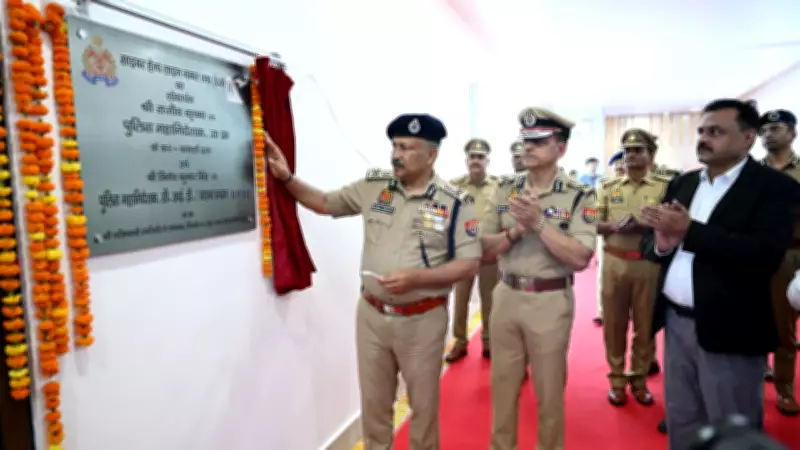
LUCKNOW: In a significant upgrade to Uttar Pradesh's cybercrime response infrastructure, Director General of Police Rajeev Krishna on Monday inaugurated the expanded Cyber Fraud Mitigation Centre (CFMC) and the upgraded 1930 Cyber Helpline Standalone 2.0 Centre at Kalli Paschim Police Lines in Lucknow. This development substantially enhances the state's ability to respond to cyber financial frauds in real time.
Expanded Capacity and Infrastructure
The upgraded facility now boasts a total of 80 operator seats, nearly six times the capacity of the state's first cyber helpline setup. Uttar Pradesh's cyber helpline journey began in January 2021 under the number 155260 with just 14 operator desks. After the nationwide rollout of the 1930 cyber helpline in 2022, capacity remained at 14 seats before being expanded to 20 in November 2023. In July 2025, the state's first standalone cyber response centre increased capacity to 50 seats. With the inauguration of Standalone 2.0, another 30 seats have been added, bringing the total strength to 80 operators.
Collaboration with Banking Sector
The inauguration was attended by RBI Regional Director Pankaj Kumar, NABARD Chief General Manager Pankaj Kumar, and Bank of Baroda General Manager and SLBC Convenor Shailendra Kumar Singh, highlighting the growing partnership between law enforcement and the banking sector in combating cyber fraud. Addressing the gathering, DGP Rajeev Krishna emphasized that cyber fraud investigations are a race against time. "In cybercrime cases, not just the golden hour but the golden minutes are crucial. Immediate reporting on 1930 significantly improves the chances of freezing fraudulent transactions and saving victims' money," he said.

Key Features of the Upgraded Centre
- 80 operator seats for handling cyber fraud complaints
- Real-time coordination with banks and financial institutions
- Enhanced capability to freeze suspicious transactions
- Improved response times for victims
DGP Krishna stated that the expanded infrastructure would further strengthen the state's ability to trace fraud proceeds, secure victims' money, and disrupt the financial networks used by cyber criminals. He praised the efforts of DG Cyber Crime Binod Kumar Singh, cyber headquarters officials, and banking partners in establishing the upgraded facility.
Cyber Fraud Mitigation Centre (CFMC) Expansion
DG, Cyber/CID/112, Binod Kumar Singh, noted that a key pillar of the state's cybercrime strategy is the Cyber Fraud Mitigation Centre (CFMC), which acts as a coordination hub between police, banks, and financial institutions. The network has expanded rapidly since its inception. "Starting with representatives from major banks in September 2025, the CFMC now has 19 banks and 20 banking representatives integrated into its response system. The roster includes SBI, Bank of Baroda, Punjab National Bank, HDFC Bank, IndusInd Bank, RBL Bank, Canara Bank, Union Bank, Kotak Mahindra Bank, Indian Bank, Bank of India, Indian Overseas Bank, UCO Bank, YES Bank, Punjab & Sind Bank, UP Gramin Bank, and UP Cooperative Bank, among others," said Singh.
Officials indicated that the direct presence of bank representatives has substantially reduced response times for freezing suspicious transactions and placing liens on fraudulently transferred funds. DG BK Singh revealed that this system helped save ₹466.9 crore between April 2025 and April 2026 by securing liens and freezing transactions linked to cyber fraud complaints. "The state's weighted lien efficiency rose to 25.7% during FY 2025-26, nearly double earlier levels. In April 2026, lien efficiency touched a record 37.3%, the highest monthly performance recorded so far," said the officer.