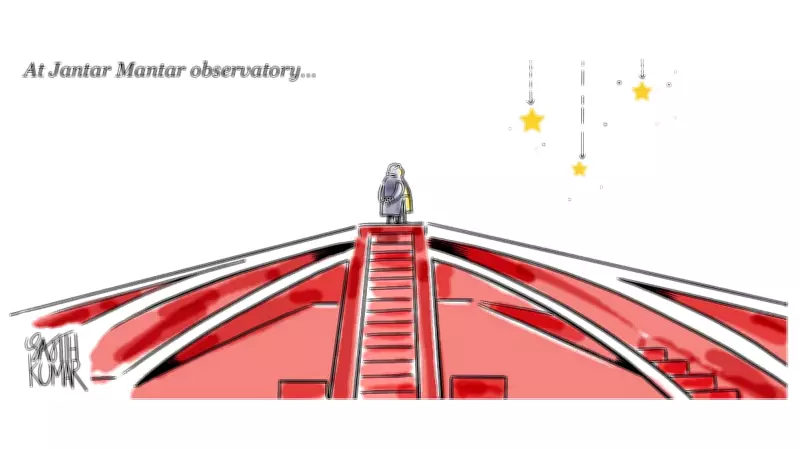
Jantar Mantar, the historic astronomical observatory in New Delhi, continues to captivate visitors with its colossal stone instruments designed to measure time, track celestial bodies, and predict eclipses. Built in 1724 by Maharaja Jai Singh II of Jaipur, this UNESCO World Heritage site is one of five such observatories he constructed across India.
A Legacy of Precision Astronomy
The observatory comprises 13 major architectural instruments, each serving a specific astronomical purpose. The most striking is the Samrat Yantra, a 27-meter-high sundial that can tell time to an accuracy of two seconds. Its shadow moves at a rate of 1 mm per second, a testament to the precision of 18th-century Indian astronomers.
Another notable instrument is the Jai Prakash Yantra, which measures the position of the sun and stars. The Ram Yantra is used to determine altitudes and azimuths. These structures are not merely scientific tools but also architectural marvels, combining form and function in sandstone and marble.

Historical Significance
Maharaja Jai Singh II, a keen astronomer and mathematician, commissioned the observatories after finding existing astronomical tables inaccurate. He sent scholars abroad to study European and Islamic astronomy and integrated the findings into Indian methods. The Delhi observatory was the first of the five, followed by Jaipur, Ujjain, Varanasi, and Mathura (the latter now lost).
The instruments are based on the principles of gnomonics (sundial design) and are designed to be used with the naked eye. They reflect a synthesis of Hindu, Islamic, and European astronomical traditions.
Visitor Experience Today
Today, Jantar Mantar is a popular tourist attraction in central Delhi, near Connaught Place. Visitors can walk among the structures and learn about their functions through guided tours and informational plaques. The site is open daily from sunrise to sunset, and entry fees are nominal. It attracts both history buffs and science enthusiasts.
According to the Archaeological Survey of India, the site receives thousands of visitors each month. Its inclusion in the UNESCO World Heritage list in 2010 as part of the 'Jantar Mantar, Jaipur' (the Jaipur observatory) boosted global recognition. However, the Delhi observatory remains a quiet retreat amid the city bustle.
Preservation Challenges
Maintaining the stone instruments requires constant care. Pollution, weathering, and urban encroachment pose threats. The ASI has undertaken restoration projects to clean and stabilize the structures. In 2022, a major conservation effort was launched to restore the original markings and scales on the instruments.
Despite these challenges, Jantar Mantar stands as a proud symbol of India's scientific heritage. It reminds us that centuries before modern telescopes and satellites, Indian astronomers were mapping the heavens with remarkable ingenuity.