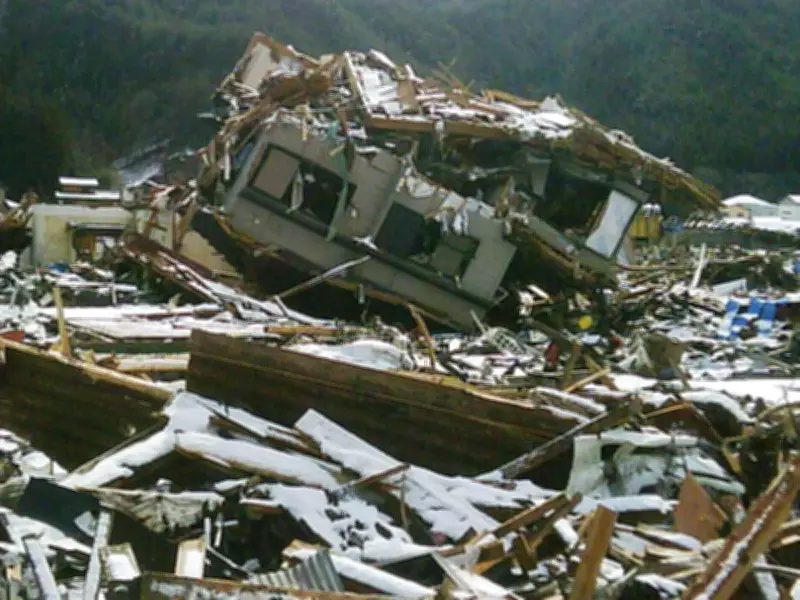
When the magnitude 9.0 Tohoku earthquake struck Japan on March 11, 2011, it was already one of the most catastrophic and closely monitored disasters in modern history. According to NOAA's National Centers for Environmental Information, as of March 2026, the Japan National Police Agency reported 15,901 deaths and 2,519 people missing and presumed dead from the Great East Japan earthquake and tsunami. However, buried in those statistics was a puzzling phenomenon that defied explanation.
Approximately 16 minutes after the main quake, before any major aftershocks occurred, GPS stations across Japan recorded a sharp eastward shift. This movement happened simultaneously nationwide and did not correspond to any known aftershock. More than a decade later, scientists believe they have finally identified the cause.
The Wave That Traveled to the Core and Back
The research team, led by Sunyoung Park, a geophysicist at the University of Chicago, and including Hiroo Kanamori of Caltech and Luis Rivera of the University of Strasbourg, proposed that a wave of energy from the original earthquake traveled straight down through the planet, struck Earth's liquid outer core, and bounced back to the surface. This returning wave induced a new slip along two major tectonic plate boundaries near Japan. The combined effect permanently shifted the entire island nation eastward by up to 6 millimeters, roughly the thickness of two stacked nickels, as reported by the University of Chicago News.

Japan sits at the convergence of four tectonic plates, a region prone to constant seismic activity. The wave responsible, known as an ScS wave, is a type of shear wave that travels through the mantle and reflects off the boundary with Earth's liquid outer core before heading back upward. The round trip spanned about 3,600 miles, equivalent to the distance from New York City to Tokyo, and took approximately 15 minutes.
Why It Took Over a Decade to Discover
Scientists were already aware that energy from massive earthquakes can penetrate deep into the planet and reflect off the core. However, this study is the first to link such a deep reflected wave to a physical slip in tectonic plates at the surface, far from the original quake's epicenter. Earthquake monitoring instruments are typically designed to detect short, high-frequency signals associated with earthquakes that people can feel. As Park explained, no one was searching for a slow, broad signal covering an entire country, and the data were difficult to analyze due to the chaos following the 9.0 earthquake and tsunami. It required painstaking cross-referencing of GPS and seismic readings from stations across Japan for Park's team to isolate the signal and trace its origin.
The Largest Seismic Event Ever Recorded
The newly identified event spanned approximately 1,800 miles, making it the largest seismic event ever recorded, according to the University of Chicago News. It released energy equivalent to a magnitude 7.5 earthquake, independent of the original 9.0 mainshock. This event is also the first known instance involving simultaneous movement along two major tectonic plate boundaries: the Pacific and Okhotsk plates, and the Philippine Sea and Eurasian plates. The most likely explanation is that the original earthquake weakened the plate boundaries, making it easier for the returning wave to reactivate movement across a wider region. As Park noted, this demonstrates that large earthquakes can continue to influence faults even after the main shaking has ceased.
Implications Beyond Japan
These findings are more than a historical footnote. Published in the journal Science under the title 'ScS-triggered slip on megathrust interfaces after the 2011 MW 9.0 Tohoku-Oki earthquake' by Sunyoung Park et al., the study identifies a seismic hazard previously unknown to scientists. Park described it as adding a new dimension to seismic hazard assessment, where the effects of a major earthquake can reverberate from deep within the planet and trigger fault movement long after the shaking has stopped. For a country like Japan, situated at the intersection of several tectonic plates, this is a significant consideration. It serves as a reminder that even one of the largest recorded seismic events can still conceal secrets until the right questions are asked of the data.

This article is based on reporting from the University of Chicago News and the journal Science.