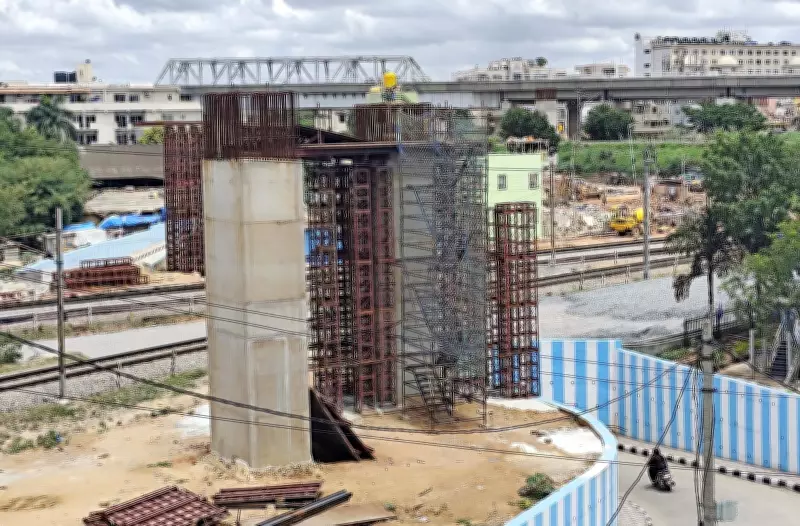
Bengaluru: The city’s Metro expansion has hit a prolonged pause, with not a single new corridor entering the construction stage in more than four-and-a-half years. The last project to break ground was the extended Airport Line (KR Pura to KIA), contracts for which were awarded by BMRCL in November 2021, and construction commenced in early 2022. Since then, no fresh project has entered execution.
Shift from Late Commissioning to Absence of New Projects
The delay has shifted attention from the familiar issue of late commissioning to a more fundamental concern: the absence of new projects reaching the construction stage despite rising travel demand. Two major projects under Phase III and Phase IIIA remain stuck in the approval pipeline.
Phase III: The Orange Line
Under Phase III, the 45-km Orange Line comprises two corridors: JP Nagar 4th Phase-Kempapura and Hosahalli-Kadabagere. The state approved the project in November 2022 and forwarded it to the Centre, which approved it in August 2024 at an estimated cost of Rs 15,611 crore. However, the state government’s decision to add a 37.1-km double-decker corridor, featuring a road flyover at Level 1 and Metro viaduct at Level 2, introduced fresh delays. The flyover component, costing Rs 9,700 crore, is to be fully funded by the state. Though the BMRCL Board approved the proposal in May 2025, it later decided in January 2026 to engage RITES for a quick study of the revised project structure before submitting it to the Ministry of Housing and Urban Affairs (MoHUA). The corporation is now awaiting clearance.

Phase IIIA: Sarjapur-Hebbal Corridor
The 37-km Sarjapur-Hebbal corridor under Phase IIIA faces a similar situation. Proposed in 2023 and approved by the state government in December 2024, the line includes a 14.3-km underground stretch and a 23.52-km elevated section. Originally estimated at Rs 28,405 crore, the proposal was sent to the Centre in January 2025. During scrutiny, BMRCL officials said the Centre suggested redesigning underground stations to reduce costs and recommended dropping the proposed station near the Veterinary College on Ballari Road. The revised detailed project report brought the project cost down to Rs 25,999 crore. MoHUA also expressed reservations about the state’s proposal for a double-decker structure, arguing that it could dilute the objectives of a mass transit system. BMRCL subsequently engaged IIT Roorkee to examine the feasibility of the concept. The project is awaiting further approvals, even as tenders have been floated for a few packages.
Political Push for Expedited Approvals
During a recent visit to New Delhi, Chief Minister DK Shivakumar urged Union Housing and Urban Affairs Minister Manohar Lal Khattar to expedite approvals. He pointed out that nearly two years had elapsed since the Orange Line received sanction and argued that the double-decker corridor was essential to ease severe congestion.
Consequences of Delays
Officials said delays in approvals have significant consequences, including annual cost escalation of at least 5%, land acquisition challenges, and postponement of critical public transport infrastructure. Based on the Comprehensive Mobility Plan, a DPR is prepared and submitted to the state government for approval, which forwards it to the Centre. The MoHUA, the nodal ministry, then refers it to the Institute of Urban Transport for technical examination, observations, and revisions, if required. The revised DPR is circulated among nine ministries, including Railways and Road Transport, and agencies such as NITI Aayog. After the state furnishes the required information and clarifications, the Public Investment Board (PIB) deliberates on the proposal and, if satisfied, forwards it for the Union Cabinet. “Currently, the process takes nearly two years. Any design change introduced midway further prolongs approvals. The Orange Line is a case in point,” the source said.

Rising Vehicle Population vs. Stagnant Metro Network
The delays come at a time when Bengaluru’s vehicle population has surged. More than 22.6 lakh vehicles have been added to city roads over the past four-and-a-half years. Yet, after nearly 15 years of operations, Namma Metro’s network stands at only 98 km, averaging around 6.5 km of expansion annually. Project delays have also inflated costs. Phase II, spanning 72 km, was sanctioned at Rs 26,405 crore and scheduled for completion within five years. Owing to prolonged delays, the revised cost has risen to Rs 40,425 crore, an escalation of nearly 53 percent over the original estimate.