

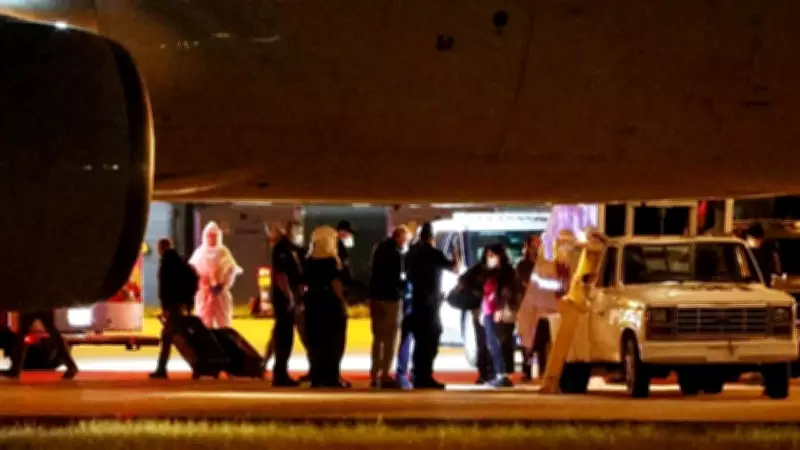
Seventeen American citizens and one British national based in the United States arrived at Eppley Airfield early Monday morning, marking the latest phase of a global effort to contain a rare hantavirus outbreak originating from the cruise ship MV Hondius. The group was transported from Spain's Canary Islands to Nebraska, home to the nation's only federally funded specialized quarantine unit.
Two individuals under close watch
Among the arrivals are two individuals of particular concern to health authorities, both of whom were transported in specialized biocontainment units aboard the aircraft. One passenger tested "mildly" positive for the virus during European screenings. Though currently asymptomatic, they have been taken directly to the Biocontainment Unit at the University of Nebraska Medical Center (UNMC).
A second passenger reported a mild cough on May 6. While the cough has resolved and they have not tested positive, they are being monitored closely. The remaining passengers have been moved to the National Quarantine Unit for initial assessment.

High-containment facility
The passengers are being housed in a facility designed for "high-consequence infectious diseases," previously used to treat Ebola and early Covid-19 patients. The setup includes 20 single-person suites (300 sq. ft.) featuring negative air pressure systems. Despite the high security, rooms function like hotel suites with Wi-Fi, exercise equipment, and en suite bathrooms to accommodate long stays.
Following the assessment, some passengers may be allowed to return home via private transport to continue their observation period locally.
Government response
The US Department of Health and Human Services supported the US Department of State in the repatriation of 17 American citizens from the ship affected by the Andes variant of hantavirus. Because the incubation period for the Andes virus strain can last up to six weeks, the CDC has mandated a rigorous follow-up protocol. Once released from Omaha, passengers will undergo daily home-based monitoring for 42 days.
Those deemed "high-risk" will be advised to limit activities outside the home and avoid extensive social interactions. Local health departments in at least five states (AZ, CA, GA, TX, VA) are already monitoring other passengers who disembarked earlier.
Global health perspective
World Health Organisation Director General Tedros Adhanom Ghebreyesus has emphasized that while the situation is serious, it remains a low risk to the general public. "I want to express my support for the government of Spain and others as they manage the hantavirus in close coordination with our World Health Organisation colleagues. While the current public health risk from the virus remains low, it's important that international health efforts ensure the safety of all, including passengers and crew of the MV Hondius," Guterres said in a post on X.
The hantavirus outbreak was first reported to the WHO on May 2 and remains a low risk to the general public, the global health agency says. The cruise ship left Argentina on April 1 and docked early this month in Spain's Canary Islands.
Transmission and cases
The Andes strain of hantavirus is typically spread via rodents, but this outbreak is under scrutiny for rare human-to-human transmission after three deaths—a Dutch couple and a German national—occurred among those linked to the MV Hondius voyage. To date, there are eight total cases (six confirmed, two probable) associated with the ship.
When asked about hantavirus, US President Donald Trump said, "We have very good people looking at the hantavirus. It seems to be okay. They know the virus very well; they've worked with it for a long time. They know it very well. It is not easy to pass on, so we hope that's true. We seem to have things under very good control with the hantavirus. They know that virus very well. It's been around a long time. It is not easily transferable, unlike COVID, but we'll see. We're studying it very closely. We have very good people studying it very closely."






