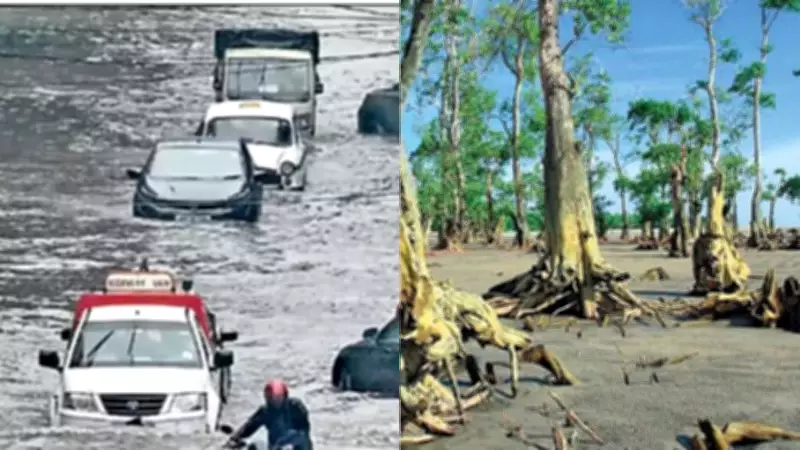
A new climate report has highlighted increasing pressure on West Bengal's coastal districts, including South 24 Parganas, East Midnapore, the Sundarbans delta, and the Kolkata metropolitan region. The report, titled “Indian Coastal Region: Climate Projections 2021–2040”, uses high-resolution 25 km x 25 km climate data to map district-level changes against a 1960s baseline. It relies on CMIP6 climate model projections corrected for regional bias, allowing a closer assessment of risks across coastal districts.
Rising Temperatures and Rainfall Shifts
The report projects summer maximum temperatures in South 24 Parganas and East Midnapore to rise by about 1°C, increasing the need for heat-resilient infrastructure, public health preparedness, and local adaptation planning. The study also projects a significant shift in rainfall patterns. East Midnapore could see Northeast monsoon rainfall rise by up to 11%, raising concerns over flooding, crop losses, waterlogging, and stress on already vulnerable coastal settlements.
Sundarbans: A Region Under Multiple Stresses
In the Sundarbans, the report highlights the combined impact of rising salinity, embankment breaches, and ecosystem degradation. Frequent breaches have allowed saline water to enter agricultural fields and groundwater sources, affecting farming, drinking water access, and public health. The report links rising salinity in the region to increased skin diseases and menstrual health challenges among women. The risks are particularly serious for the Sundarbans, one of the world’s largest mangrove ecosystems and a natural barrier against cyclones and storm surges. Local communities, especially women-led groups, have been involved in mangrove restoration efforts to protect villages from coastal erosion and tidal surges.

Kolkata’s Exposure
Kolkata, though not a seafront city, remains exposed because of its location in the lower Ganga delta and its connection to the Hooghly river system. Rising temperatures, heavier rainfall events, tidal influence, drainage congestion, and cyclone-related flooding could intensify risks for the city’s dense population, transport systems, informal settlements, and critical infrastructure.
Urgent Need for Adaptation
The report warns that the 1.5°C warming threshold is likely to be reached across India’s administrative regions in the near future, shrinking the time available for adaptation. “Climate change is not some distant future challenge, it is the reality of today. 2040 is just 14 years away,” said Anurag Behar, CEO, Azim Premji Foundation. “This dataset brings to life the impacts of climate change with much greater immediacy, highlighting how we must restructure our infrastructure and governance to ensure we collectively address this crisis.”
Harini Nagendra, Director, School of Climate Change and Sustainability at Azim Premji University, said the findings show that climate risks are now local and immediate. “The data in this report is a mirror that reflects a reality we can no longer afford to ignore. For decades, we treated climate change as a global abstraction, a problem of polar ice caps and distant centuries. But our findings show that for the Indian coastline, the crisis is hyper-local and immediate. Whether it is the heat stress in Ernakulam or the rising salinity in the Sundarbans, our vulnerability is visible in all aspects of our daily lives,” she said.
Broader Coastal Trends
Across India’s coastal belt, the report projects average temperatures to rise by 1.5°C, with around 40 coastal districts likely to experience summer temperature increases of more than 1°C. It also warns of dangerous wet-bulb heat in coastal Keralam and Tamil Nadu, stronger monsoon rainfall along the west coast, sea-level rise, erosion, and increasing cyclone intensity linked to warming sea surface temperatures. Under a moderate emissions pathway, global sea levels are projected to rise by 15 cm by 2050, a trend that could worsen erosion and displacement in low-lying coastal regions. The report also notes that sea surface temperatures are rising at about 0.27°C per decade, increasing the likelihood of intense tropical cyclones.

Recommendations for Bengal’s Coast
For Bengal’s coast, the findings reinforce the urgency of strengthening embankments, restoring mangroves, improving cyclone shelters, protecting freshwater sources, upgrading drainage systems, and integrating climate projections into district-level planning. The report states that the period up to 2040 must be treated as an immediate planning horizon for coastal adaptation rather than a distant climate scenario.