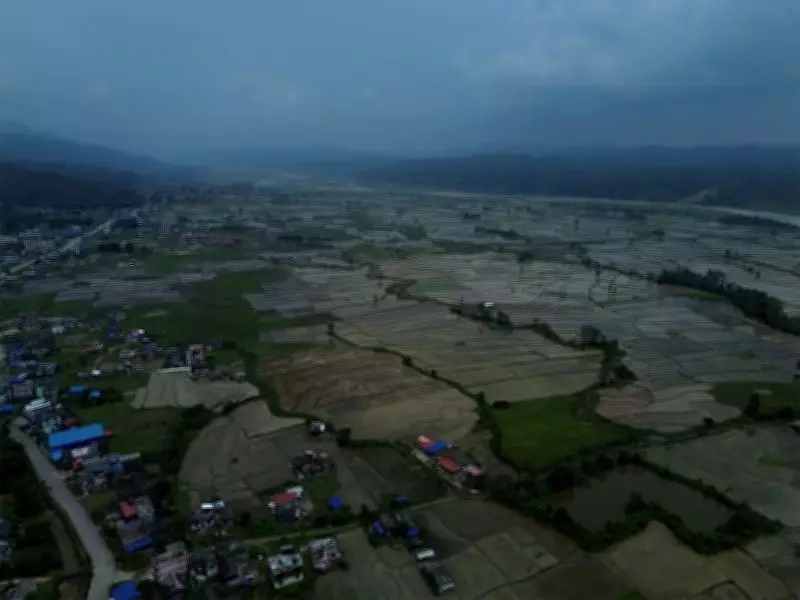
Nepali farmers in Sindhuli district celebrated National Paddy Day on June 29 with traditional tug-of-war, ploughing fields with oxen, and splashing mud and water, even as the El Nino phenomenon threatens a drier monsoon season this year.
Celebrations Amidst Drought Concerns
The Marin Rural Municipality organized the annual Ropain Mela, attracting hundreds of participants who engaged in traditional paddy transplantation activities. Bimarsha Moktan, chairman of the municipality, told ANI that the event included ploughing fields using traditional methods and special songs sung during transplantation, with participation from various ethnic groups. The celebration, observed on Ashar 15 since 2005, marks the start of the rice planting season and includes feasts featuring beaten rice, curd, pickle, and home-brewed alcohol, earning it the name "Dahi (Curd)-Chiura (Beaten Rice)" eating day.
Monsoon Forecast and El Nino Impact
About 80% of Nepal's annual rainfall occurs during the June-September monsoon, with an average of 1,600 mm. However, the Department of Hydrology and Meteorology has forecast below-average rainfall for most of Nepal in the 2026 monsoon season due to El Nino. The outlook indicates a 55% to 65% probability of below-average rainfall in southern and northern Karnali Province, most of Lumbini Province, eastern Madhesh, and southern Koshi. Meteorologists attribute the weakening monsoon to El Nino, which causes abnormal warming of Pacific surface waters and disrupts atmospheric circulation, reducing South Asian monsoon strength.

Agricultural Significance and Production
Nepal produces about 5.5 million metric tonnes of paddy annually, but consumption is 7 million metric tonnes, leaving a deficit of about 1 million tonnes. Paddy is cultivated from 60 metres above sea level in the Terai to 3,000 metres in Jumla's hills. According to the National Agricultural Census 2021, 67% of Nepal's 4.13 million farming households cultivate paddy. Productivity has increased from 3.80 metric tonnes per hectare in 2019-20 to 4.19 metric tonnes per hectare in 2024-25. Paddy fields cover 54% of cultivated land, contributing 13% of agricultural GDP and generating an estimated Rs 200 billion annually.
Local Adaptation Measures
In response to the drought threat, the Marin Rural Municipality has procured irrigation equipment worth one crore rupees, including motors and pipes, to ensure water supply. Moktan told ANI that the local body is distributing these to farmers to enable lift irrigation from ponds, rivers, and wells during dry spells. "We have taken measures to ensure the flow of water for agricultural needs, the winter season, unseasonal crops and possible drought even during the monsoon," he said.
Risks of Erratic Rainfall
Scientists warn that despite a weaker monsoon, short-term heavy rainfall could cause flash floods and landslides. The International Centre for Integrated Mountain Development's Hindu Kush-Himalaya Monsoon Outlook 2026 projects below-average rainfall in Bhutan, India, Nepal, and Pakistan, with above-average temperatures. Hydrologist Manish Shrestha of ICIMOD said, "Even with a weaker monsoon, short-term heavy rainfall remains a major concern." Co-author Sarthak Shrestha noted that reduced snow cover stability weakens natural water storage, making river systems more sensitive to rainfall variability.
Need for Integrated Disaster Preparedness
Experts emphasize the need for robust early warning systems and impact-based forecasting. Neera Shrestha Pradhan, Head of Water and Disaster Risk Reduction at ICIMOD, said, "More robust coordination between governments, technical agencies and local levels is needed for future preparedness." Ranit Chatterjee, CEO of Rika India, warned that erratic rainfall after dry spells increases landslide risk, exacerbating socio-economic pressures like migration and food price hikes. Senior Advisor Arunabhabhakta Shrestha added, "Early warning systems, short-term forecasts and local-level preparedness need to work together to face increasingly complex risks."