

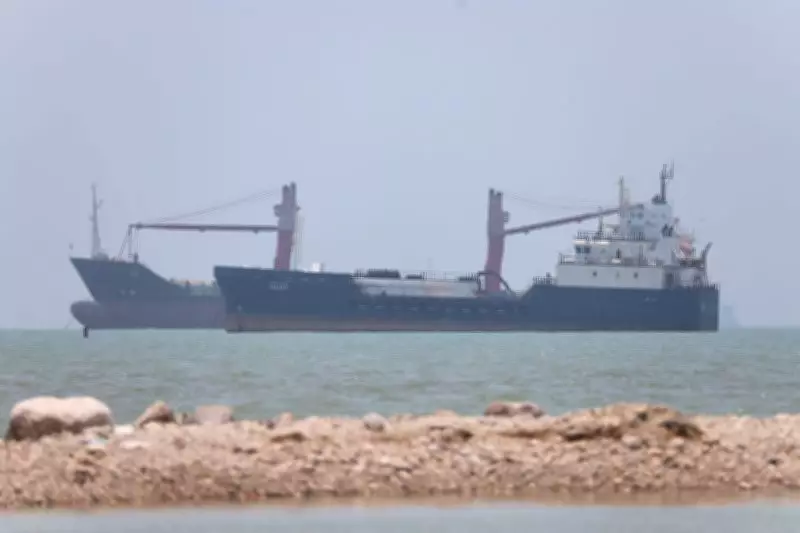
The United Nations International Maritime Organization (IMO) suspended its escort operations for ships navigating the Strait of Hormuz on Thursday following an attack on a cargo vessel near Oman. This incident has reignited fears that the preliminary ceasefire agreement between the United States and Iran may not hold.
Attack on the Ever Lovely
The British navy agency UKMTO reported that a cargo ship was struck by a projectile close to Oman. Two US officials informed Reuters that Iran was responsible for the attack, while Iran's Persian Gulf Strait Authority warned vessels against using unauthorized routes. The authority stated that ships deviating from designated paths would not be guaranteed safe passage, and any consequences would fall on the owner, operator, and commander.
Four sources identified the vessel as the Singapore-flagged Ever Lovely, and a security source indicated that a drone likely targeted the ship. The US government has not yet commented on the incident.

IMO Halts Evacuation Program
The IMO had been assisting hundreds of stranded ships and thousands of seafarers who had been trapped in the strait since the war began in late February. IMO Secretary General Arsenio Dominguez announced the temporary pause, stating it was necessary to reconfirm safety guarantees for ships on the evacuation list and all vessels in the region. He noted that the attacked ship was not part of the IMO's evacuation program.
The initiative, launched on Tuesday, offered a voluntary option for ships to exit the Gulf via two routes—one through Iranian waters and another through Omani waters—with US oversight.
Market and Geopolitical Impact
Following reports of the attack, benchmark oil prices rose by 2%, reflecting renewed concerns about the timeline for restoring normal Gulf oil flows. Before the conflict, the Strait of Hormuz handled a fifth of the world's daily oil and liquefied natural gas supplies.
US Secretary of State Marco Rubio, during a tour of the Gulf, warned that if Iran threatens or blocks ships, "then we're going to have a problem." Iran's Revolutionary Guards reiterated that safe passage is only possible through Iran-designated routes and threatened action against non-compliant vessels. British maritime security company Ambrey reported that the Guards ordered two Panama-flagged ships to change course on Thursday.
Oil Flows and Political Ramifications
Despite the incident, US Energy Secretary Chris Wright claimed that shipments through the strait were nearing pre-war levels, with at least 20 million barrels of oil exiting the waterway in the previous 24 hours. Other shipping data confirmed that crude shipments rose to their highest level since the war began in February. South Korea's Oceans Ministry reported that eight more South Korean vessels had exited the strait.
The war has become a significant issue for US President Donald Trump ahead of November midterm elections. A Reuters/Ipsos poll showed that only one in four Americans believes the war was worth the cost. Conflicting accounts about the ceasefire deal have drawn criticism domestically and internationally.
Disagreements Over Ceasefire Terms
Disputes persist over financial incentives for Iran, nuclear inspections, control of the Strait of Hormuz, and Israel's parallel war in Lebanon. Iran's top negotiator, Mohammad Baqer Qalibaf, denied the US assertion that Iran would use unfrozen assets to buy US agricultural products. The deal establishes 60 days of talks to address thornier issues, including Iran's nuclear program.






