
4 Tech Axes Shaping Next 25 Years: Bio, AI, Space, Energy
As 2025 ends, a look at the four transformative tech axes—synthetic biology, AI, space, and energy—that will redefine our world by 2050. Will institutions adapt?

As 2025 ends, a look at the four transformative tech axes—synthetic biology, AI, space, and energy—that will redefine our world by 2050. Will institutions adapt?

Punjab Agricultural University (PAU) in Ludhiana secures top spot in PMRF list with 21 fellowships. Discover how this boosts agri-research and India's scientific talent.
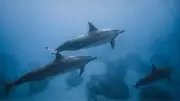
In 2004, a lifeguard and his daughter were encircled by dolphins off New Zealand. Discover the full story of this incredible marine rescue and what science says. Read more!

For India's Anusandhan National Research Foundation to succeed, it must adopt DARPA's high-risk model, not become a bureaucratic fund. Expert analysis on its potential.

Babraham University researchers have developed a lab model of the human womb lining, enabling unprecedented study of early embryo implantation. This breakthrough could reveal causes of pregnancy failure and new treatments. Read the full story.

Federal research funding cuts under Trump disrupted US universities. Pittsburgh lost $24M & 104 jobs. Academic freedom and critical health disparity studies are under threat. Explore the impact.

Confused between BSc Biotechnology and Microbiology? This guide breaks down the curriculum, lab work, and career opportunities for both science degrees to help you make an informed choice for your future.

The National Medical Commission has published the official NEET UG 2026 syllabus. Aspiring medical students for 2025 can now plan their studies using this NCERT-only blueprint. Start your focused preparation today!
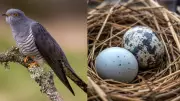
Discover the fascinating evolutionary strategy of brood parasitism. Learn why cuckoos lay eggs in crow nests, the science behind this deception, and how it ensures their survival. Dive into the details now!
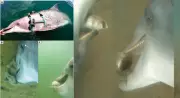
Underwater footage from US Navy-trained dolphins reveals their powerful suction hunting and consumption of venomous sea snakes, shattering their friendly image. Discover the surprising facts.
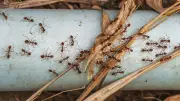
New research reveals ant species evolved by reducing individual body armour, freeing resources to build massive, complex colonies. This trade-off between quality and quantity drove their evolutionary success.

Jamia Millia Islamia researchers contribute to a major international study on social connection and health, published in Nature. Discover the key findings and India's role.

Gujarat State Biotechnology Mission partners with Biotech Consortium India Limited to accelerate innovation, tech transfer, and translational cancer research. Experts highlight need for better clinical outreach.

Hundreds of scientists at a Visakhapatnam conference commit to developing alternatives to lab animals while acknowledging their crucial role in biomedical research. Read about the key pledges and expert insights.
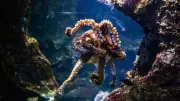
Discover how the octopus's three hearts and unique physiology allow it to survive cardiac pauses. This marine marvel offers crucial insights for medical research on organ survival in low oxygen.
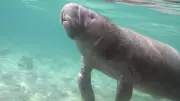
Fossils of a new sea cow species discovered in Qatar's Early Miocene rocks show striking similarity to modern dugongs, revealing their role as ancient ecosystem engineers of seagrass habitats.

Japanese scientists discover a marine bacterium, Photobacterium angustum, that targets and destroys colon cancer cells with high precision, offering a potential new treatment.

India produces only 10,000 science PhDs yearly, lagging far behind the US and China in research output. Experts warn this gap threatens the vision of a $3 trillion knowledge-based economy. Read more.

Bihar govt launches ONOS scheme to provide free access to 30,000+ global research journals, aiming to bridge the urban-rural digital divide and boost state's research profile. Read more.
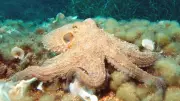
Discover the incredible science behind the octopus's three hearts and blue blood. Learn why swimming exhausts them and how their unique physiology dictates their ocean-floor lifestyle.

Celebrating 100 years, the Central Coffee Research Institute in Balehonnuru has released 13 high-yield arabica selections & robusta hybrids, revolutionizing India's coffee cultivation through systematic breeding. Discover the legacy.

Scientists were stunned to find hammerhead sharks living inside Kavachi, an erupting underwater volcano. Discover how this 'Sharkcano' defies marine biology and what it means for science.

Learn how the principle of contribution in marine insurance impacts claim settlements when multiple policies cover the same risk. Essential reading for Indian shippers and exporters.
Union government acknowledges global gender bias in medical research, citing differences in disease manifestation for women. Details Rs 400+ crore funding push via ICMR & DBT for women's health and research.

Bhabha Atomic Research Centre plans a strategic new R&D campus on 3000 acres in Anakapalli. The project, crucial for energy and national security, gets in-principle forest land approval. Read more.

Discover the science behind a lizard's ability to detach and regrow its tail. Learn how this clever survival trick works and the costs involved. Read more about nature's ingenious design.
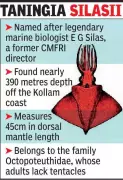
Indian scientists discover a rare new species of deep-sea squid, Taningia silasii, in the Arabian Sea. Read about this groundbreaking marine find and its unique features.
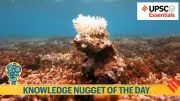
India will establish its first National Coral Reef Research Institute in South Andaman at a cost of Rs 120 crore. Learn why coral reefs are vital for UPSC and the environment.

Gujarat's policy think tank GRIT invites non-academic research proposals in key areas like Net Zero and tribal development. Apply online by Dec 15, 2025.

Delhi University's Jesus and Mary College collaborates with national universities to explore longevity science, blending Himalayan wisdom with modern research under NEP's holistic framework. Discover the future of healthy living.