India and Brazil Deepen Strategic Ties with Landmark Agreements
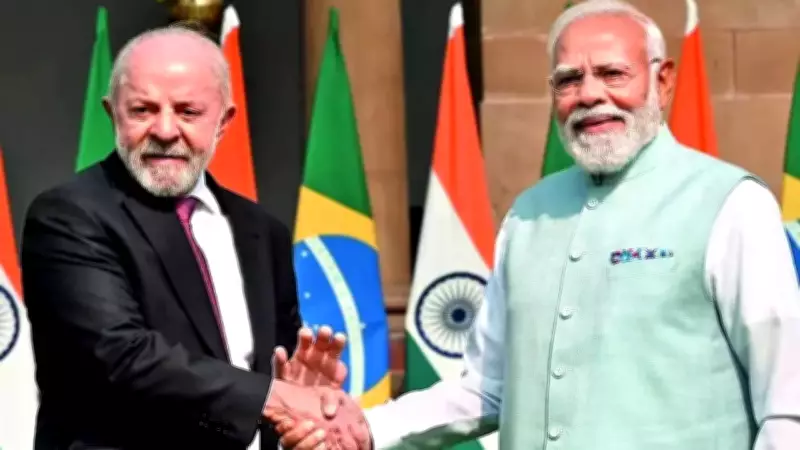
In a significant diplomatic engagement, Prime Minister Narendra Modi and Brazilian President Luiz Inacio Lula da Silva held a comprehensive bilateral meeting on Saturday, resulting in a series of pivotal agreements aimed at bolstering cooperation across multiple sectors. The discussions, held in New Delhi, centered on enhancing economic collaboration, technological innovation, and shared geopolitical objectives, particularly within the Global South.
Key Agreements and Economic Targets
The leaders announced a bilateral trade target of $30 billion by 2030, marking a substantial increase from current levels. This ambitious goal is supported by nine signed agreements, including a crucial pact on cooperation in rare earths and critical minerals. This agreement is seen as a strategic move to reduce dependence on China and build resilient supply chains, with PM Modi highlighting its importance for global economic stability.
Additionally, Brazil has agreed to extend business visas for ordinary Indian passport holders to 10 years, facilitating easier travel and business interactions. The expansion of India’s trade agreement with Mercosur, a South American trading bloc, was also emphasized as a step to strengthen economic cooperation further.

Technological and Energy Collaboration
Technology emerged as a central theme, with both leaders underscoring the need for inclusive innovation that acts as a bridge for shared progress. PM Modi stated, "We are also prioritising our cooperation in areas such as artificial intelligence, supercomputers, semiconductors, and blockchain." This focus aligns with the vision of both nations as digital and renewable energy superpowers, respectively.
Energy cooperation was highlighted as a strong pillar of the relationship, with increasing collaboration in renewable energy, ethanol blending, and sustainable aviation fuel. President Lula remarked that the meeting was between a digital superpower and a renewable energy superpower, reflecting the complementary strengths of the two countries.
Defense and Security Enhancements
Defense and security cooperation received significant attention, with PM Modi describing it as a perfect example of mutual trust and strategic harmony. The joint statement reaffirmed defense as an integral pillar of the India-Brazil Strategic Partnership, emphasizing the potential for co-design and co-production by linking India’s Atmanirbhar Bharat initiative with Brazil’s defense industrial base.
Both countries strongly condemned cross-border terrorism, including specific incidents such as the Pahalgam terrorist attack and the Red Fort blast, showcasing a united stance on security issues.
Global South Solidarity and UN Reforms
The leaders emphasized their role as crucial voices in international forums like the UN, WTO, and G20. PM Modi stated, "As democratic countries, we will continue to advance the priorities and aspirations of the Global South. When India and Brazil work together, the voice of the Global South becomes stronger and more confident."
A strong focus was placed on UN reforms, particularly the expansion of the Security Council in both permanent and non-permanent membership categories. Both countries reaffirmed their commitment under the G4 framework, which includes Japan and Germany, to support each other’s candidatures for permanent membership. India welcomed Brazil’s support for its non-permanent seat bid for the 2028-29 term.
Critical Minerals and Trade Implications
During the meeting, President Lula provided a detailed presentation on Brazil’s substantial critical minerals and rare earth reserves, noting that only 30% have been explored. He expressed Brazil’s interest in partnering with India for exploration, processing, and utilization of these resources.
The leaders also discussed the recent US Supreme Court judgment striking down former President Donald Trump’s global tariffs. MEA secretary (east) P Kumaran indicated that both sides would adopt a wait-and-watch approach to study the implications for their trade, reflecting cautious optimism in navigating global economic uncertainties.

President Lula addressed trade unilateralism in his remarks, stressing the need to strengthen strategic dialogue in a turbulent world. This aligns with the broader goal of fostering a more equitable global trade environment.
In conclusion, the meeting between PM Modi and President Lula has set a robust framework for future collaboration, with agreements spanning minerals, technology, defense, and global governance. The emphasis on Global South solidarity and mutual support in international arenas underscores the deepening strategic partnership between India and Brazil, poised to influence global dynamics positively.