

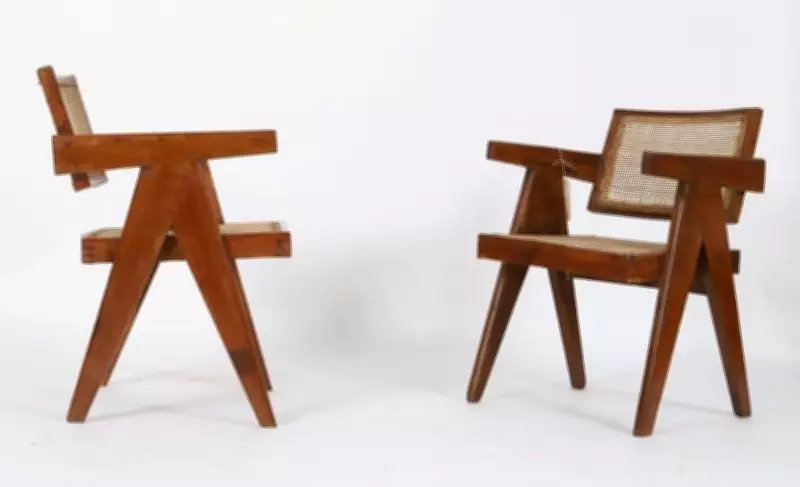
India has formally begun the process of repatriating two Pierre Jeanneret-designed chairs stolen from Panjab University (PU) and the Postgraduate Institute of Medical Education and Research (PGIMER) in Chandigarh, after the Ministry of External Affairs (MEA) and the Permanent Delegation of India to UNESCO jointly halted their scheduled auction in Paris on Wednesday. The development marks the first time in over a decade that an overseas sale of Chandigarh's modernist heritage furniture has been stopped by official government action, with criminal cases filed and a formal repatriation request initiated.
Diplomatic Intervention and Legal Groundwork
Sources in the MEA confirmed that all efforts are being made to secure the return of the two chairs to India. “We have achieved the first breakthrough in stalling the auction, which was itself a historic first. Now we are hopeful of winning our second battle — the repatriation of our stolen heritage furniture back to India,” a senior MEA official said, adding that processes and procedures for such diplomatic action have been formally initiated with France and that the chairs are expected to be back “shortly.”
The intervention followed an urgent communication from the Chandigarh Administration, which prompted the MEA and UNESCO's delegation to act swiftly. “The letter made the legal and cultural case in a manner that gave us the grounds to move fast,” the source added.

Governor Welcomes Action, Calls for Systematic Response
Punjab Governor and Chandigarh Administrator Gulab Chand Kataria, who had taken suo motu cognisance of a series of reports in The Tribune on the Paris auction and earlier sales in Brussels and Chicago, welcomed the action. “Chandigarh’s heritage furniture is not merely government property, it is the soul of this city, an inseparable part of India’s cultural identity and a legacy that belongs to every resident of Chandigarh, to every Indian who takes pride in what this city represents,” Kataria said.
“What we have demonstrated this week is that when the Administration, the Centre, the MEA and our diplomatic missions act in concert and act fast, we can stop this. The question now is how we build this into a permanent, systematic response — not just for the two chairs in Paris but for every piece of Chandigarh’s heritage that has left this country over the past two decades,” he added.
Heritage Activist Calls It a Watershed Moment
Heritage activist and advocate Ajay Jagga, who alerted authorities to the auction, described the development as “a watershed moment” in Chandigarh’s heritage conservation movement. “The challenge now is to ensure this becomes the template, not the exception,” he said.
Chronology of Events Leading to the Halt
The chain of events began on June 22 when Jagga sent a representation to External Affairs Minister S Jaishankar, Culture Minister Gajendra Singh Shekhawat and Indian Ambassador to France Sanjeev Singla, alerting them to the imminent Paris sale. The two chairs listed by Parisian auctioneer François Epin carried inventory codes that made their government provenance unmistakable: PU/Chem/55 for a chair from Panjab University’s Chemistry Department and PGI/W/CH-0202 for a chair from PGIMER.
Acting on the matter, Governor Kataria directed the Chief Secretary to respond immediately. On June 23, the Administration's Secretary, Culture, addressed a strongly-worded communication to the Joint Secretary (UNES), MEA, describing the sale as a matter of “national and international cultural importance” and urging the MEA to engage the Indian Embassy in France and French authorities to halt the auction at once.
The letter argued that the sale would be “prima facie illegal” under Indian law and “explicitly in contradiction of UNESCO’s framework for transboundary heritage regarding illegal export and trade of art and antiquities,” as well as the UNIDROIT Convention on Stolen or Illegally Exported Cultural Objects — to which France is a signatory. The Administration sought immediate suspension of the auction, preservation of the furniture pending investigation, ownership verification, repatriation assistance and identification of other Chandigarh heritage pieces in international markets.

On the same day, Chandigarh Police registered two FIRs — No. 0080 and No. 0081, both dated June 23, 2026 — under Sections 305(e) and 61(2) of the Bharatiya Nyaya Sanhita, initiating criminal investigations into the suspected theft, illegal removal, export, sale and trafficking of the chairs. The filing of the FIRs was critical: it gave India's diplomatic request the formal criminal investigation backing that French authorities would need to justify intervening in a scheduled auction on French soil.
Significance of the Breakthrough
The Paris intervention is the first time in over a decade of continuous international auctions — across more than 100 sales since 2009, fetching an estimated Rs 40-50 crore — that an overseas auction of Chandigarh heritage furniture has been stalled by official government action, that criminal cases have been filed over such outflow and that India has formally initiated a repatriation process for any of the pieces. Previous interventions, including advance representations to the MEA and Ministry of Culture ahead of a Brussels auction on June 18 — where seven pieces sold for Rs 1.6 crore despite 48 hours’ written notice — had yielded no preventive action.
The breakthrough has also exposed the legal pathway that previous responses had missed. France’s status as a UNIDROIT Convention signatory means that India’s criminal cases and formal government request create a legal obligation on French authorities to engage — a lever that the 1972 Antiquities and Art Treasures Act, under which the Archaeological Survey of India twice ruled that Chandigarh furniture does not qualify for protection, had never provided.





