

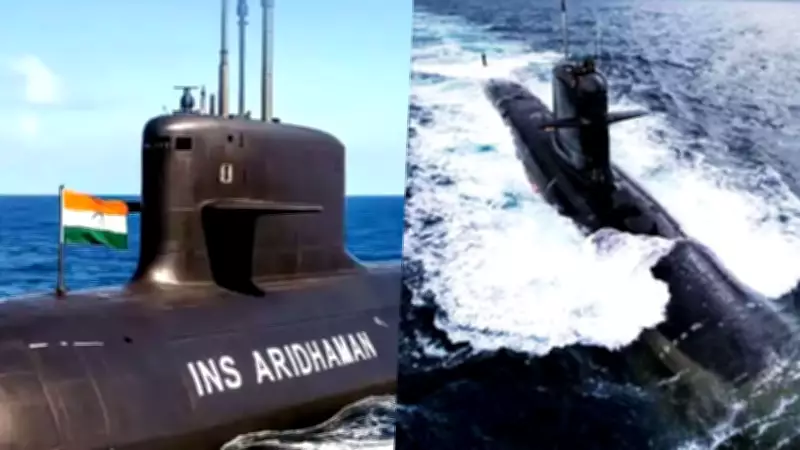
India's Nuclear Submarine Triad Strengthens With INS Aridhaman Joining INS Arihant and INS Arighaat
India is poised to significantly enhance its naval nuclear capabilities with the imminent induction of INS Aridhaman, the third Arihant-class nuclear ballistic missile submarine. This strategic development, reported on February 24, 2026, marks a pivotal moment in India's defense posture, quietly reshaping the military balance across Asia and the Indian Ocean region.
Building a Formidable Underwater Nuclear Shield
With INS Aridhaman joining its predecessors, INS Arihant and INS Arighaat, India now operates a formidable trio of indigenous SSBNs (Ship Submersible Ballistic Nuclear). This achievement represents a major milestone in India's quest for a robust and survivable nuclear deterrent. The deployment of these three submarines brings the nation closer to achieving Continuous At-Sea Deterrence, a critical capability that involves maintaining at least one nuclear-armed submarine on patrol at all times.
This continuous presence ensures that India retains a credible second-strike capability, even in the event of a devastating first strike against its land-based nuclear assets. The strategic importance of this capability cannot be overstated, as it provides a powerful deterrent against potential adversaries.

Advanced Armament and Strategic Implications
The Arihant-class submarines are armed with sophisticated submarine-launched ballistic missiles, including the K-15 and the longer-range K-4 missiles. These weapons systems enable India to project nuclear power from the depths of the ocean, offering a stealthy and resilient means of retaliation.
The induction of INS Aridhaman specifically enhances India's ability to counter threats from both Pakistan and China, two nuclear-armed neighbors with whom India has complex geopolitical relationships. By diversifying its nuclear delivery platforms, India strengthens its position in regional security dynamics, ensuring that its deterrent remains credible and effective.
Reshaping the Strategic Equation
The operationalization of this nuclear submarine triad fundamentally alters the strategic calculus in the Indian Ocean and beyond. It underscores India's commitment to maintaining a secure and stable regional environment while safeguarding its national interests. The ability to deploy nuclear-armed submarines provides India with a flexible and survivable option for deterrence, reducing the likelihood of conflict escalation.
Moreover, this development highlights India's growing technological prowess in defense manufacturing, as all three submarines are indigenously built. It reflects years of dedicated research, development, and strategic planning, positioning India as a significant player in global nuclear deterrence architecture.
In conclusion, the induction of INS Aridhaman is not merely an addition to India's naval fleet; it is a transformative step that solidifies India's nuclear triad—comprising land, air, and sea-based delivery systems. This enhancement ensures that India's nuclear deterrent remains robust, credible, and capable of safeguarding the nation's security in an increasingly complex geopolitical landscape.






