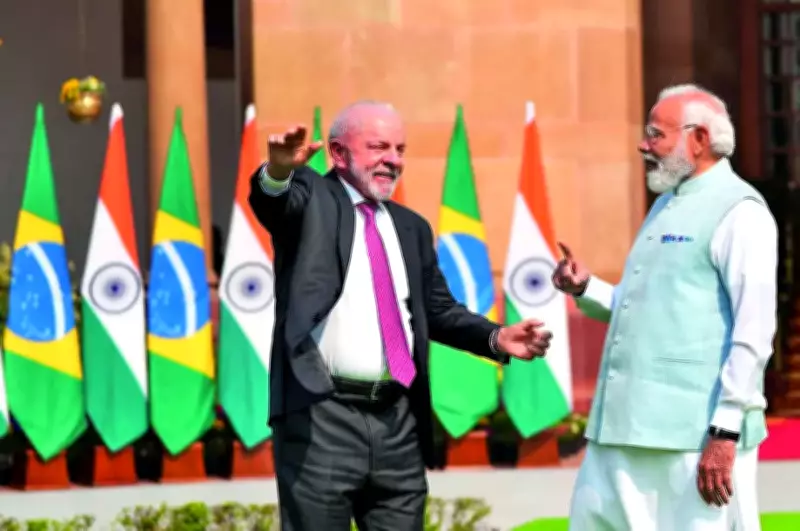
Brazil's Lula Issues Stark Warning to Trump on Cold War Risks
Brazilian President Luiz Inacio Lula da Silva has delivered a pointed caution to his United States counterpart, Donald Trump, against instigating a new Cold War, while strongly advocating for the principle of equal treatment among all nations globally. The remarks came during a press conference in New Delhi, just ahead of President Lula's departure from India, following a highly productive bilateral meeting with Prime Minister Narendra Modi.
Direct Appeal for Global Equality
"I want to tell US President Donald Trump that we don't want a new Cold War. We don't want to interfere in any other country, we want all countries to be treated equally," President Lula stated emphatically. This direct message underscores growing international concerns about geopolitical tensions and trade policies. The Brazilian leader is scheduled to travel to Washington next month for a meeting with President Trump, where these critical issues are likely to be discussed further.
Strategic Partnership with India Flourishes
During his visit, President Lula lauded the deepening strategic partnership between Brazil and India, describing it as a model relationship between peers that consciously rejects the "authoritarianism" often perceived in negotiations with wealthier, more powerful nations. Speaking at the India-Brazil Economic Forum, Lula emphasized the profound, deep-rooted similarities between the two large democracies and their shared vision for sustainable growth and development.

"What is really more important is that when we're talking about a negotiation with a country like India, we are not dealing with a colonizer," Lula observed, highlighting the unique nature of this bilateral bond. He contrasted this with dealings involving affluent countries, which he suggested often fail to account for the individual happiness and sovereignty of partner nations. "With India, it's different," he affirmed, pointing to a balanced power dynamic where "no one is above the other country." This equilibrium, according to Lula, springs from a mutual understanding of shared needs, challenges, and attitudes.
Shared Challenges Foster Collaboration
President Lula noted that despite obvious differences in religion, language, and culture, Brazil and India face remarkably similar developmental challenges. This shared perspective, he argued, makes it "much easier for us to work and to establish an action plan" and to effectively build robust partnerships between entrepreneurs and industries from both nations. This ease of collaboration has already yielded impressive economic results, creating a significant and positive trajectory for bilateral relations.
Trade Growth Exceeds Expectations
The economic fruits of this partnership are substantial and growing. Since President Lula's first visit to India, bilateral trade has skyrocketed from $2.4 billion to an impressive $10.5 billion. While Prime Minister Modi had previously set an ambitious target of reaching $20 billion in trade by 2030, President Lula expressed even greater optimism and ambition during his remarks. "We'll reach $30 billion of trade," he confidently declared, signaling strong mutual commitment to expanding economic ties.
Key Agreements Signed
The bilateral meeting between PM Modi and President Lula also resulted in the signing of a pivotal pact for cooperation on critical minerals, a sector of strategic importance for both economies. Additionally, the two leaders exchanged views on the recent US Supreme Court judgment that struck down President Trump's sweeping global tariffs, discussing its implications for international trade and multilateral relations.
President Lula's visit and his subsequent statements reinforce the strengthening axis between two major Global South powers, united by a vision of equitable international relations and mutual economic prosperity, while sending a clear message about the desired direction of global diplomacy in an increasingly multipolar world.