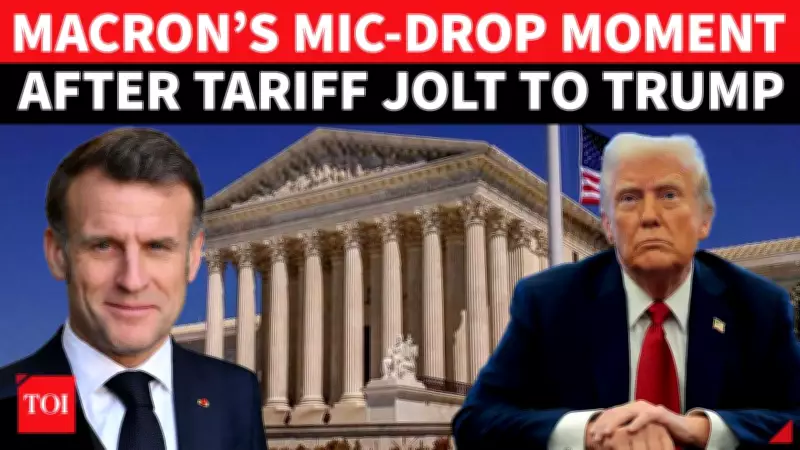
Macron Delivers Subtle Rebuke to Trump After Supreme Court Tariff Ruling
In a pointed diplomatic maneuver, French President Emmanuel Macron appeared to take a thinly veiled swipe at former U.S. President Donald Trump following a significant legal setback for the American leader. The remarks were delivered during an address in Paris, shortly after the U.S. Supreme Court struck down sweeping tariffs that had been a cornerstone of Trump's economic policy.
Emphasis on Judicial Oversight and Democratic Principles
Macron's commentary focused on the foundational role of judicial institutions in maintaining democratic balance. "It is not bad to have a Supreme Court and therefore the rule of law," he stated, with a tone that observers interpreted as a direct critique of Trump's approach to governance. The French leader elaborated on the necessity of "counterweights to power" in functional democracies, implicitly contrasting the American system's checks and balances with Trump's perceived disregard for judicial authority.
Context of Trump's Tariff Strategy and Legal Defeat
The backdrop to Macron's remarks is a contentious period in U.S. trade policy. The Supreme Court's decision to invalidate broad tariffs represented a major legal blow to Trump, who has consistently advocated for aggressive trade measures. Despite this judicial setback, Trump has moved forward with plans to introduce new tariffs, signaling a determination to persist with his economic agenda regardless of legal challenges.

This dynamic underscores a broader tension between executive action and judicial review, a theme Macron highlighted in his speech. His comments resonate within international diplomatic circles, where concerns about the stability of U.S. policy and adherence to legal norms have been growing.
International Implications and Diplomatic Undertones
Macron's statement is more than a mere observation; it carries significant diplomatic weight. By publicly affirming the value of the rule of law and judicial institutions, he positions France as a defender of democratic principles on the global stage. This stance may be seen as a subtle endorsement of the Supreme Court's ruling and a critique of Trump's attempts to circumvent it.
The timing of the remarks is particularly noteworthy, coming as Trump seeks to rally support for new tariffs. Macron's emphasis on "counterweights to power" serves as a reminder of the importance of institutional restraints in preventing unilateral executive actions that could disrupt international trade and diplomacy.
Broader Reactions and Political Landscape
While Macron did not mention Trump by name, the context leaves little doubt about the target of his comments. This incident adds to a history of diplomatic friction between the two leaders, who have previously clashed over issues ranging from climate change to NATO funding. Macron's critique aligns with broader European concerns about the unpredictability of U.S. trade policy under Trump's influence.
In summary, Macron's remarks in Paris serve as a sophisticated diplomatic critique, using the platform to champion democratic values while indirectly challenging Trump's approach to governance. The episode highlights ongoing tensions between the U.S. and its allies over trade, legal norms, and the role of institutions in safeguarding democratic processes.