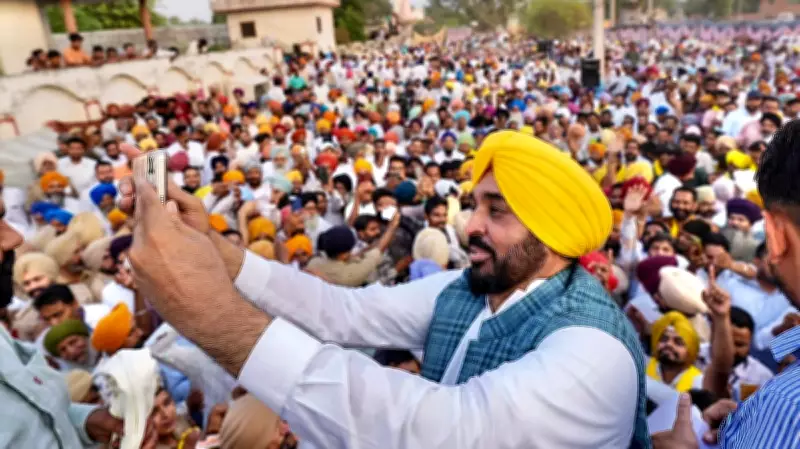
The political landscape in Punjab has been rocked by a major controversy as Chief Minister Bhagwant Mann faces a severe backlash over alleged sacrilege incidents. Across Sikh shrines, including the revered Golden Temple in Amritsar, hoardings have been put up declaring Mann a 'Guru dokhi' (anti-Guru) and 'Khalsa Panth Virodhi' (anti-community) following an edict issued by the Akal Takht, the highest temporal authority of Sikhs.
Akal Takht's Edict and Its Implications
The Akal Takht's directive, issued on June 25, 2026, calls upon the Sikh community to boycott Mann and his government. The edict stems from accusations that Mann's administration failed to prevent and properly investigate incidents of sacrilege involving the Guru Granth Sahib. According to Sikh clergy, this inaction amounts to betrayal of the faith. The hoardings, which have appeared in major gurdwaras across the state, explicitly label Mann as an enemy of the Sikh Panth.
Opposition's Political Offensive
Opposition parties, including the Shiromani Akali Dal (SAD) and the Congress, have seized upon the controversy to attack the Aam Aadmi Party (AAP) government. SAD president Sukhbir Singh Badal stated, 'The Akal Takht's declaration is a historic rebuke to Mann's anti-Sikh policies. He must resign immediately.' Congress leader Partap Singh Bajwa accused Mann of 'playing with the sentiments of the Sikh community for political gain.' The opposition has demanded a probe into the sacrilege cases and called for Mann's resignation.

Government's Response and Damage Control
The Punjab government has attempted to downplay the edict, with Mann's aides calling it a 'misunderstanding.' A government spokesperson said, 'The CM respects the Akal Takht and is committed to upholding Sikh traditions. We are in dialogue with the clergy to resolve the issue.' However, no official statement has been issued by Mann himself. The AAP leadership in Delhi has also remained largely silent, leaving the state unit to handle the crisis.
Background of the Sacrilege Controversy
The row dates back to incidents in 2025 when copies of the Guru Granth Sahib were found desecrated in several districts. The opposition accused the Mann government of a cover-up and delaying arrests. In response, the Akal Takht summoned Mann to appear before it, but he failed to do so, leading to the current edict. Sikh historian Dr. Jaswant Singh noted, 'This is unprecedented in recent history. The Akal Takht rarely declares someone anti-Panth, and when it does, it carries immense moral weight.'
Impact on Sikh Community and Politics
The edict has deeply polarised the Sikh community. While many devout Sikhs have heeded the call to boycott Mann, others see it as a political move by the clergy. Social media is abuzz with debates, with hashtags like #BoycottMann and #SaveSikhPanth trending. Political analysts believe this could significantly impact AAP's prospects in the upcoming 2027 assembly elections. 'This is a game-changer. If the boycott holds, AAP's support base among Sikhs will erode,' said political commentator Ruchika Sharma.
Meanwhile, security has been tightened around Mann's residence and government buildings in Chandigarh. The Punjab Police have been put on alert to prevent any untoward incidents. The situation remains tense as the state awaits the clergy's next move.