

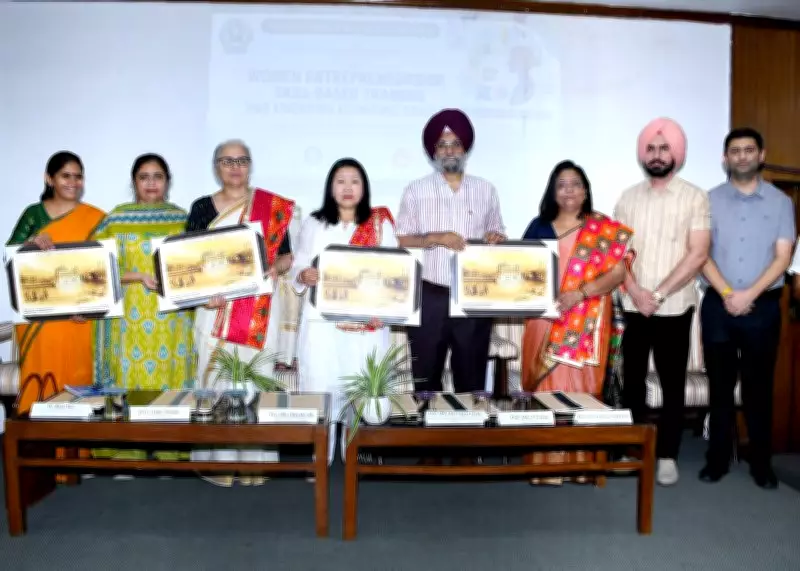
The Department of Sociology and Political Science at Guru Nanak Dev University (GNDU), in collaboration with the Research Committee on Gender Studies (RC-10) of the Indian Sociological Society, New Delhi, organised a two-day seminar-cum-workshop and mid-term conference on “Women Entrepreneurship, Skill-Based Training and Emerging Economic Spaces” at Guru Nanak Bhawan.
Hybrid event draws national participation
Held in a hybrid mode with support from RUSA 2.0’s Golden Jubilee Centre for Entrepreneurship and Innovation (GJCEI), the event brought together scholars, researchers, teachers, practitioners and students from across the country to deliberate on issues related to women’s economic empowerment, livelihood opportunities and skill development.
The seminar was conceived as an academic and participatory platform to examine contemporary challenges in gender and development studies. Discussions focused on women entrepreneurship, skill-based training and emerging economic spaces as key avenues for strengthening women’s economic agency, self-reliance and leadership.

Keynote highlights educational-workforce paradox
Delivering the keynote address, Prof Rajesh Gill highlighted the paradox between women’s educational achievements and their participation in the workforce. She observed that despite the existence of 73 Central Government and 433 state-level welfare schemes, only a small proportion of women were able to benefit. Referring to the fact that more than 43 per cent of STEM graduates in India were women, she expressed concern over the significant gap between educational attainment and workforce participation.
Prof Ajailiu Niumai lauded the enthusiastic academic response to the conference, noting that 85 abstracts had been received and presented across nine technical sessions conducted in both online and offline formats.
Chief guest outlines key challenges
Addressing the gathering as the chief guest, Prof Abha Chauhan structured her remarks around three interrelated themes—skill-based training, women entrepreneurship and emerging economic spaces. She identified key challenges hindering women’s empowerment, including patriarchy, social evils such as dowry, cultural and institutional barriers, inadequate skill-training programmes, weak implementation of self-help groups, the persistent digital divide, poverty and lack of education.
Vice-Chancellor on conference objectives
Vice-Chancellor Prof Karamjit Singh said the conference aimed to examine women entrepreneurship as a pathway to economic agency and social mobility, assess the role of skill-based training in improving employability and livelihoods, and analyse emerging economic spaces such as digital markets, cooperatives, self-help groups and community-based enterprises.
He added that the programme also sought to identify barriers to women’s access to credit, technology, training, markets and leadership opportunities, while fostering dialogue on inclusive and sustainable models of economic empowerment.
Platform for policy dialogue
The organisers said the conference provided a valuable platform for exchanging ideas and exploring policy interventions to promote women’s participation in the evolving economic landscape.






