

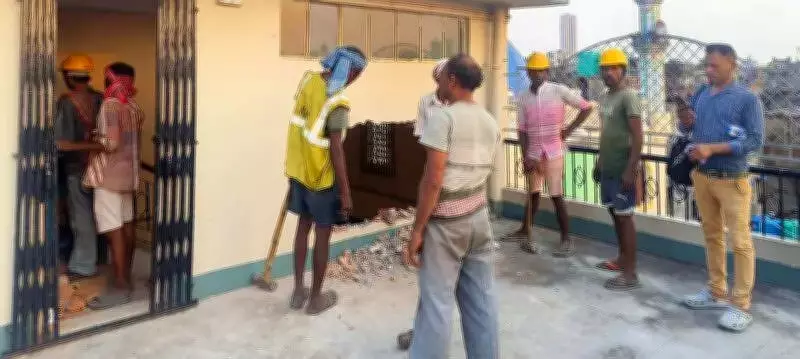
Residents of Kolkata's Tiljala area watched in shock on Wednesday evening as two payloaders rolled into a narrow lane and began tearing down parts of a building where two labourers had died in a fire the previous day. The loud crash of breaking concrete echoed through the congested locality as people stood observing the demolition with a mix of fear, disbelief, and uncertainty. Many spoke in hushed tones, discussing how such constructions had mushroomed in the area over the years. For several locals, the demolition was not just about one building but reflected a larger problem that has persisted under the administration's nose.
Residents Question How Illegal Buildings Were Allowed
"People are shocked seeing a building demolished like this. But how were these buildings allowed to come up in the first place? Politicians and officials have made money, but poor people are becoming homeless," said a local resident. The Kolkata Municipal Corporation (KMC) has marked the Topsia-Tiljala stretch as a red zone for demolition, alongside Garden Reach-Metiabruz, Rajabazar, Burrabazar, and pockets off EM Bypass. According to a KMC buildings department official, no fewer than 1,000 structures in the Tiljala-Topsia belt are awaiting demolition. Internal civic assessments indicate that around 70% of the buildings constructed in the area over the past decade are illegal.
Enforcement Challenges and Political Patronage
"There is rapid real estate pressure, weak monitoring, and a hostile ground environment in this pocket. Borough-level buildings department staff are hesitant to inspect areas, fearing backlash. A colleague who once attempted to inspect an illegal construction in Tiljala was abused and threatened by rowdies allegedly linked to an influential developer with political connections," said a KMC official. This fear-driven retreat has serious consequences. When officials cannot inspect sites, issue stop-work notices, or supervise demolition, illegal structures gain time to become permanent. Once occupied, connected to utilities, and woven into the local economy, demolition becomes administratively harder and politically riskier. Delayed enforcement rewards violators and weakens the credibility of municipal regulation.

The Tiljala-Topsia belt also exposes a structural flaw in Kolkata's urban governance: laws exist, and demolition lists exist, but implementation collapses where local resistance is organized and coercive. Similar difficulties in Burrabazar-Rabindra Sarani and other dense neighborhoods show that this is not merely a planning problem but an enforcement deficit shaped by political patronage, local muscle power, and inadequate protection for civic staff.
Commercial Use of Residential Buildings Adds Risk
In Tiljala, several locals alleged that many residential buildings were being used for commercial purposes. They claimed that small-scale production units and workshops often operate in such structures, increasing pressure on already congested neighborhoods and posing serious safety concerns. "Many buildings here are not purely residential anymore," said another resident. "There are factories, storage spaces, and production units inside them. If something goes wrong, it puts everyone living nearby at risk."
Residents said many flat owners had invested their life savings to buy homes and now face uncertainty over their future. Some locals questioned why ordinary buyers should bear the consequences alone if authorities failed to act during the construction phase itself. "The government must find a solution for the families living there," said another local.






