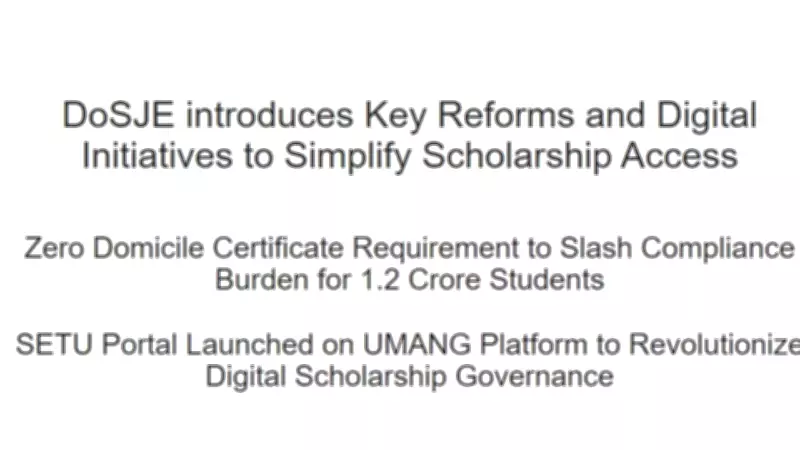
The Department of Social Justice and Empowerment (DoSJE) has introduced a series of reforms and digital initiatives aimed at making scholarship schemes more accessible for Scheduled Caste (SC) and Other Backward Classes (OBC) students across the country.
Removal of Domicile Certificate Requirement
One of the most significant changes is the elimination of the domicile certificate requirement for students applying under the department's scholarship schemes. This move is expected to reduce paperwork and simplify the application process for students seeking financial assistance.
According to the department, the change will particularly benefit students who pursue their education outside their home states. Previously, submitting a domicile certificate was mandatory to avail benefits under these schemes.

Coverage of the Reform
The reform covers both the Pre-Matric and Post-Matric Scholarship Schemes for SC and OBC students. Nearly 1.2 crore students receive benefits under these schemes every year. With the domicile certificate requirement removed, students will have fewer documents to submit and lower compliance costs.
The department stated that this step is expected to make the application process more student-friendly and improve access to scholarship benefits for eligible students.
Launch of SETU Portal
Alongside the reform, the department has also launched SETU (Scholarship for Educational Transformation and Upliftment) on the UMANG platform. The new portal has been designed as a single-window system for scholarship-related services.
SETU will provide a common interface for applicants, Institutional Nodal Officers, District Nodal Officers, and State officials. The platform will support services such as application registration, tracking, and validation, with the aim of improving transparency and efficiency in scholarship administration.
Government's Vision
The department said these initiatives are in line with the government's objective of promoting inclusion, reducing procedural hurdles, and ensuring the effective delivery of welfare schemes. It added that technology-driven reforms will continue to be used to improve outreach and provide timely support to students.