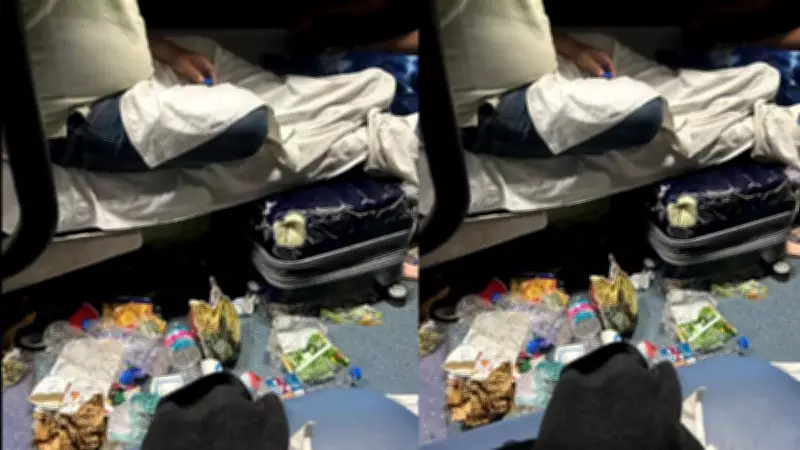
A train passenger's candid explanation for not stopping a co-traveller from littering has gone viral, igniting a conversation about the complexities of intervening in public spaces. The incident, which occurred on a long-distance train journey, was shared on social media platform X (formerly Twitter) by a user named Rohan Gupta. In his post, Gupta described how he observed a fellow passenger casually tossing a plastic water bottle and snack wrappers onto the floor of the train compartment, despite a dustbin being located just a few feet away. Rather than confront the litterer, Gupta chose to remain silent, a decision he later justified in a detailed thread that has since garnered over 2 million views and thousands of comments.
The Viral Post and Its Justification
Gupta's post, dated June 25, 2026, began with a simple observation: “I saw a man throw his trash on the floor. The bin was right there. I didn’t say anything. Here’s why.” In the ensuing explanation, Gupta outlined several reasons for his inaction. First, he noted that the litterer was accompanied by two other individuals who appeared to be friends or family, making a direct confrontation potentially risky. Second, he pointed out that the train compartment was already littered with debris from previous passengers, suggesting that the problem was systemic rather than isolated. “If the entire compartment is a mess, calling out one person feels like shouting into a storm,” Gupta wrote. Third, he expressed concern about escalating the situation into a verbal or physical altercation, especially in the confined space of a moving train. “I’ve seen how quickly arguments on trains can turn ugly,” he added.
Public Reaction and Debate
The post quickly divided opinions. Many users praised Gupta for his pragmatic approach, arguing that personal safety and the futility of confronting strangers in a dirty environment justified his silence. One commenter wrote, “You’re not a janitor. It’s not your job to police others. The railways should clean more often.” Others, however, criticized him for enabling bad behaviour. “By staying silent, you’re telling him it’s okay. That’s how public spaces get ruined,” another user replied. The debate extended to broader issues of civic responsibility, with some calling for stricter enforcement of littering fines and more frequent train cleaning. According to Indian Railways data, over 1.2 million passengers travel daily on long-distance trains, and littering remains a persistent problem despite awareness campaigns.

Expert Perspectives on Bystander Intervention
Psychologists and social behaviour experts weighed in on the incident, explaining the bystander effect and the fear of social repercussions. Dr. Anjali Sharma, a behavioural scientist at the University of Delhi, stated, “When people see others littering in a already dirty environment, they experience a diffusion of responsibility. They think, ‘Someone else will handle it’ or ‘It’s not that big a deal.’” She added that the presence of a group can also inhibit intervention due to the perceived risk of group retaliation. However, she emphasized that small actions, like picking up trash oneself, can set a positive example. “One person quietly disposing of litter can influence others more effectively than a confrontation,” she noted.
Railways’ Response and Cleanliness Initiatives
In response to the viral post, a spokesperson for Indian Railways reiterated the importance of passenger cooperation in maintaining cleanliness. “We have dustbins in every coach and conduct regular announcements urging passengers not to litter. However, we rely on passengers to self-police,” the spokesperson said. The Railways also highlighted its “Swachh Rail” initiative, which includes increased cleaning staff at major stations and on-board cleanliness drives. Despite these efforts, a 2025 survey by the Ministry of Railways found that 68% of passengers reported seeing litter inside train compartments during their journeys. The survey also noted that only 22% of respondents said they had ever confronted a litterer.

Conclusion: A Call for Collective Action
Rohan Gupta’s post has sparked a necessary conversation about the balance between personal safety and civic duty. While his decision to stay silent was rooted in practical concerns, the widespread reaction suggests that many passengers are frustrated with the state of cleanliness on trains. As one user aptly put it, “We need more bins, more cleaning, and more awareness—but also a culture where we hold each other accountable without fear.” The incident underscores that solving the littering problem requires not only systemic changes but also a shift in social norms, where passengers feel empowered to act without risking their safety.