Andhra Pradesh Government Implements AI in Healthcare Pilot Project
In a significant advancement for modernizing healthcare services, the Andhra Pradesh state government has initiated the use of artificial intelligence (AI) in government hospitals. This innovative approach aims to enable faster diagnosis and substantially improve the quality of medical treatment provided to patients across the state.
Pilot Project Details and Implementation
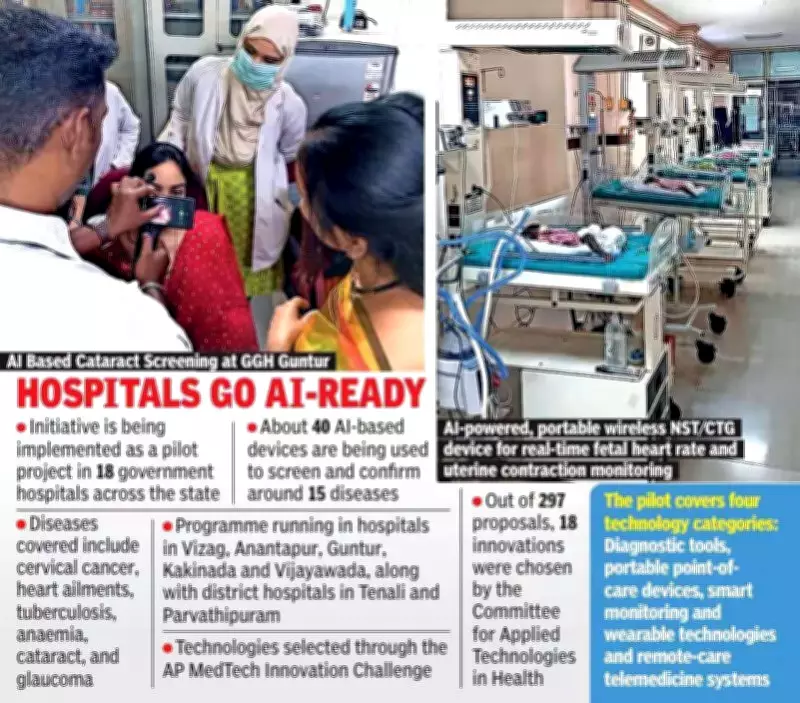
As part of a comprehensive pilot project, cutting-edge healthcare technologies developed by various startups are being implemented in 18 government hospitals throughout Andhra Pradesh. Approximately 40 advanced medical devices are currently being utilized to conduct both screening and confirmation tests for nearly 15 different types of diseases and health conditions.
Health Minister Y Satya Kumar Yadav officially announced this development on Sunday, highlighting the transformative potential of these technological interventions. The pilot program is actively underway at several prominent healthcare facilities, including Visakhapatnam Government General Hospital, Anantapur GGH, Guntur GGH, Kakinada GGH, Vijayawada GGH, along with district hospitals in Tenali and Parvathipuram, among other medical institutions.

Disease Detection and Medical Applications
The AI-powered healthcare tools are specifically designed to assist doctors in diagnosing various medical conditions more rapidly, thereby enabling medical professionals to provide timely and appropriate treatment to patients. The targeted diseases include cervical cancer, various heart ailments, tuberculosis, anaemia, cataract, glaucoma, and neurological disorders affecting children.
Senior officials within the medical department have confirmed that advanced software systems are being deployed in certain hospitals to support medical decision-making processes and streamline overall patient care management. In specific healthcare settings, AI tools are being employed to detect tuberculosis through sophisticated cough analysis, identify early-stage heart diseases, and predict potential dengue outbreaks based on comprehensive historical data analysis.
Technology Categories and Medical Innovations
According to Health Minister Yadav, the pilot program encompasses four distinct technology categories that represent the forefront of medical innovation. These categories include diagnostic tools, portable point-of-care devices, smart monitoring and wearable technologies, and remote care telemedicine systems that facilitate healthcare delivery across distances.
Portable medical devices, capable of fitting into suitcase-sized kits, are being utilized to conduct essential blood tests for monitoring sugar levels, kidney function, thyroid conditions, and other health parameters without requiring extensive diagnostic infrastructure. Wearable devices are being strategically deployed to continuously monitor patients' vital parameters, including blood pressure, pulse rate, and body temperature, with particular emphasis on intensive care units where constant monitoring is critical.
Selection Process and Future Expansion
The implementation follows a rigorous selection process that began when the health department initially received 297 proposals after inviting applications under the 'AP MedTech Innovation Challenge.' A specialized committee titled the Committee for Applied Technologies in Health (CATH) thoroughly examined all applications through three distinct evaluation stages before finally recommending 18 innovations for practical implementation in healthcare settings.
Some of the implemented systems demonstrate remarkable capabilities, including recording doctor-patient conversations and automatically generating consultation summaries and medical prescriptions. Health Minister Yadav confirmed that the pilot phase will conclude in the near future, after which a comprehensive report detailing the results and outcomes will be submitted directly to the Chief Minister for review.

Integration and Future Prospects
Based on the findings and recommendations from the pilot project report, the government will make informed decisions regarding the potential expansion of AI-based healthcare services throughout the entire state. Minister Yadav further emphasized that these advanced healthcare services will be seamlessly integrated with ABHA ID (Ayushman Bharat Health Account) to effectively digitize patient medical records and make healthcare delivery more efficient, accessible, and patient-centered for all residents of Andhra Pradesh.