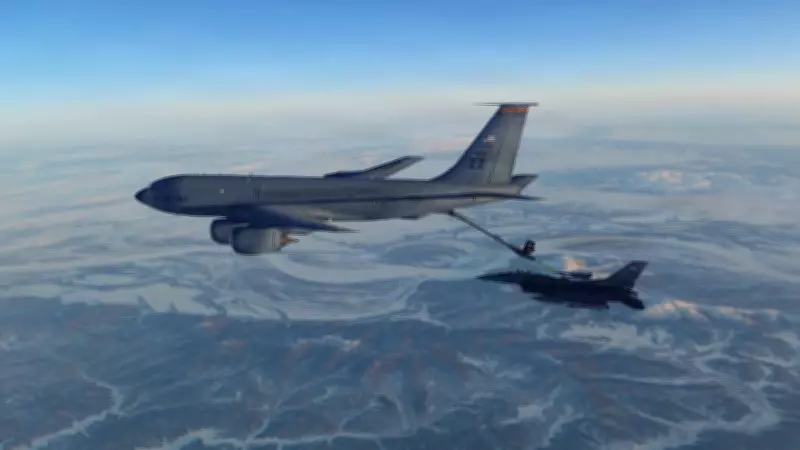
China's Military Advances AI Integration in Aerial Refueling Operations
The People's Liberation Army (PLA) has officially introduced an artificial intelligence-assisted task dispatch system designed to revolutionize aerial refueling operations. This strategic development comes just days after a tragic incident involving a US Air Force Boeing KC-135 Stratotanker in Iraq, which resulted in the loss of all six crew members during Operation Epic Fury.
AI-Driven System Optimizes Complex Air Warfare Operations
At the core of China's new military capability is an "aerial refuelling area management system" that employs sophisticated AI algorithms to monitor real-time airspace conditions and dynamically allocate refuelling tasks. The system continuously calculates multiple variables including fuel levels, flight durations, and airspace capacity to recommend optimal pairings between tanker aircraft and combat fighters.
PLA officials emphasize that this represents a significant departure from traditional methods where pilots typically selected the nearest available tanker, often leading to operational inefficiencies, congestion around certain aircraft, and underutilization of resources. The AI system aims to distribute demand evenly across available assets, reduce mission delays, and maximize operational endurance for combat aircraft.

Strategic Timing Following US Military Incident
The announcement's timing is particularly noteworthy given the recent KC-135 Stratotanker crash in Iraq. While the Pentagon has ruled out hostile fire as the cause, investigations continue into whether mechanical stress, human error, or mid-air collision factors contributed to the fatal incident. The involved aircraft belongs to a fleet dating back to the Cold War era, still extensively utilized despite decades of service.
Chinese military analysts have pointed to such incidents to highlight the limitations of aging aerial refueling systems. State media commentators argue that intense operational tempos, especially in conflict zones, place significant strain on both aircraft and personnel—risks that advanced automation systems could potentially mitigate.
Transforming Aerial Logistics Through Artificial Intelligence
Aerial refueling serves as a critical force multiplier in modern warfare, extending the operational range and endurance of fighter jets, bombers, and surveillance aircraft. Enhancements in this domain can substantially improve a military's power projection capabilities far beyond national borders.
China's integration of AI into aerial refueling operations seeks not only efficiency improvements but also aims to reduce human workload and decision fatigue—factors historically contributing to aviation accidents. The system represents part of a broader Chinese initiative to embed artificial intelligence into operational decision-making processes, particularly in high-tempo combat scenarios where speed and precision determine mission success.
Emerging Questions About AI in Combat Support Systems
While promising technological advancement, the incorporation of AI into critical combat support systems raises important considerations. Dependence on algorithmic decision-making introduces new vulnerabilities including potential system failures, cybersecurity threats, and challenges maintaining appropriate human oversight during high-stakes military operations.
The development may signal divergent approaches to aerial logistics modernization among major military powers. While the United States focuses on upgrading its tanker fleet with newer hardware platforms, China's emphasis on AI-enabled coordination suggests a parallel pathway prioritizing software-driven optimization alongside equipment improvements.
As global air forces prepare for increasingly complex and contested battlefields, efficient management of airborne assets could prove as decisive as the aircraft themselves. In this context, China's AI-assisted refueling system represents more than incremental improvement—it potentially redefines how aerial support operations are conducted, with implications extending well beyond immediate conflict theaters.

The technological advancement occurs against a backdrop of intensifying global military competition, where nations increasingly seek strategic advantages through artificial intelligence integration across defense systems. China's public demonstration of this capability serves both as a technological milestone and a strategic signal regarding its military modernization priorities.