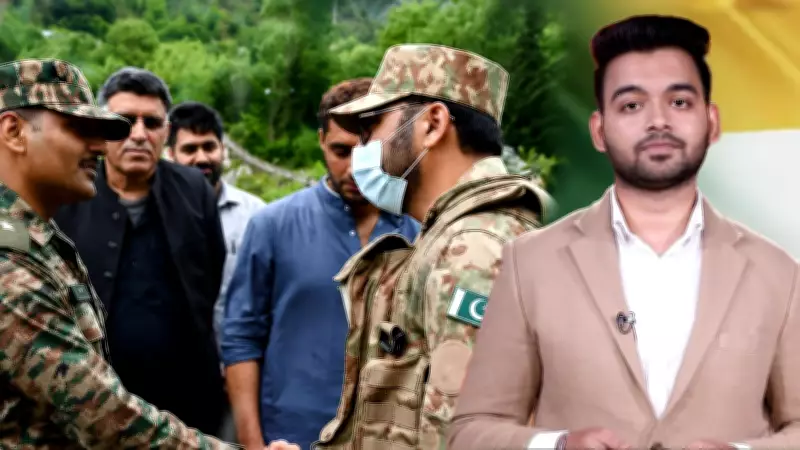
A routine repatriation has become an unusual talking point along the Line of Control. Pakistani national Asad Khan, who was detained after crossing into Indian territory in Jammu and Kashmir's Kupwara district, was handed back to Pakistan after nearly a week in custody. During the formal transfer, an Indian Army officer and a Pakistani Army officer were seen exchanging a handshake — a rare visual at one of the world's most heavily militarised borders.
Humanitarian Protocols in Focus
While the gesture does not signal any diplomatic breakthrough, it has sparked interest because it highlights the humanitarian protocols and communication mechanisms that continue to function between the two sides despite ongoing tensions. The handshake, though brief, underscores the existence of established procedures for handling such cases, which are often overshadowed by broader political and military standoffs.
Border Management Insights
Here's why the moment has drawn attention and what it reveals about border management along the LoC. The incident demonstrates that even in a highly charged environment, routine interactions can occur, reflecting a level of professionalism and adherence to agreed-upon norms. Such exchanges are not unprecedented but remain uncommon, making this instance noteworthy.

Context of the Repatriation
Asad Khan's detention and subsequent repatriation followed standard protocols, with both sides coordinating to ensure a smooth transfer. The handshake, captured by observers, quickly circulated on social media, prompting discussions about the human element in border relations. Experts note that while this does not indicate a thaw in relations, it serves as a reminder that communication channels remain open for humanitarian purposes.
Implications for Future Interactions
The event may encourage further adherence to existing agreements, but analysts caution against reading too much into a single gesture. The LoC remains a flashpoint, with frequent ceasefire violations and tensions. However, the handshake highlights that both armies can interact cordially when required, potentially paving the way for more routine cooperation on humanitarian issues.